
Does High-Hardness Feedwater Require a Softener for RO Systems? Configuration Logic from Raw Water Quality to Full-Line
When High-Hardness Feedwater Meets RO: What Actually Determines Softener Necessity
Procurement and operations teams often ask whether high-hardness feedwater requires a softener before a reverse osmosis (RO) unit. The short answer is: not always. Whether ion-exchange softening is necessary depends on scaling potential, target system recovery, membrane protection strategy, and how the treated water will be used in downstream bottling or beverage production.
At Chuxin Mingwei, water treatment configurations are engineered from actual source water quality, target water standards, production capacity, and facility constraints. This article outlines the decision logic so you can evaluate softening requirements before committing to a full-line investment.
Why Hardness Matters for RO Performance
Calcium and magnesium ions in feedwater can precipitate on RO membranes as carbonate or sulfate scales. Scaling reduces flux, increases differential pressure, shortens membrane life, and raises cleaning frequency. However, the presence of hardness alone does not dictate that a softener must be installed.
Key factors that determine scaling risk include:
- Feedwater hardness concentration and alkalinity
- Target RO recovery rate (higher recovery concentrates hardness faster)
- Membrane type and manufacturer scaling limits
- Operating temperature and pH
- Use of antiscalant dosing systems
If hardness is moderate and recovery is kept within conservative limits, antiscalant dosing may be sufficient. When hardness is high and the project requires high recovery or long run-times between cleanings, a dedicated softening stage becomes more cost-effective.
Softener vs. Antiscalant: Configuration Trade-Offs
| Decision Factor | Ion-Exchange Softener | Antiscalant Dosing |
|---|---|---|
| Primary Function | Removes Ca²⁺/Mg²⁺ via sodium exchange | Inhibits scale crystal growth |
| Capital Cost | Higher (vessels, resin, control valves, brine system) | Lower (dosing pump, tank, monitoring) |
| Operating Cost | Salt consumption, brine discharge, resin replacement | Chemical dosing, periodic monitoring |
| Recovery Impact | Enables higher RO recovery safely | Recovery limited by scaling index |
| Maintenance | Regeneration cycles, valve checks, resin bed inspection | Dosing calibration, chemical inventory |
| Best For | High hardness, high recovery, strict uptime requirements | Moderate hardness, flexible recovery, lower capex priority |
In practice, many beverage and bottled water projects combine both: a softener for bulk hardness removal and a precision antiscalant system for residual protection. The exact configuration is validated through water analysis and pilot testing.
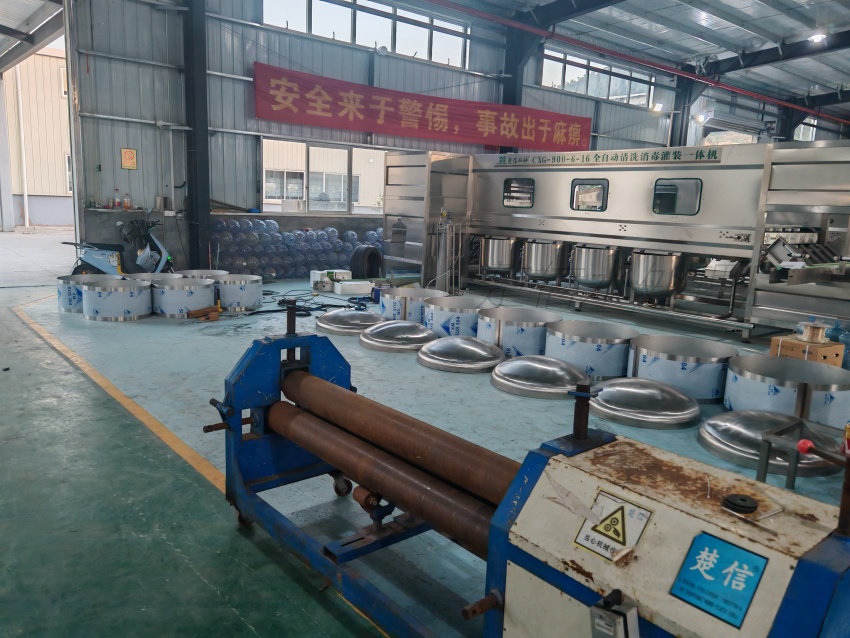
How Softening Fits Into a Complete Production Line
A softener is never a standalone solution. It must be integrated into the full water treatment and filling workflow. A typical configuration for high-hardness feedwater includes:
- Raw Water Intake & Storage – Balances supply fluctuations and allows initial settling
- Pre-Filtration – Multi-media and activated carbon remove suspended solids and chlorine
- Softening Stage – Single or dual-tank ion exchange; dual-tank enables continuous operation during regeneration
- Precision Filtration – Cartridge filters protect downstream pumps and membranes
- RO System – Single or double-stage, sized for target capacity and water quality
- Post-Treatment & Storage – UV/ozone disinfection, finished water tank, and distribution to filling lines
For bottled spring water or purified water production, the treated water must meet both safety standards and product-specific requirements. For example, spring water lines often use NF+UF processes to balance purification with mineral retention, while purified water lines rely on dual-stage RO with ozone and UV sterilization. The softening decision must align with these downstream objectives.
Decision Checklist for Procurement Teams
Before specifying a softener, verify the following:
- [ ] Complete raw water analysis (hardness, alkalinity, TDS, silica, iron/manganese, chlorine)
- [ ] Target RO recovery rate and acceptable cleaning frequency
- [ ] Membrane manufacturer scaling limits and warranty conditions
- [ ] Available space for softener vessels, brine tank, and drainage
- [ ] Local regulations on brine discharge and chemical handling
- [ ] Integration requirements with existing or planned filling lines
If your project involves high-hardness groundwater, high recovery targets, or strict production uptime, a softener is typically justified. For municipal water with moderate hardness and flexible recovery, antiscalant dosing may be sufficient.
Implementation Boundaries and Risk Notes
- Softening reduces hardness but does not remove dissolved salts, TDS, or microbial contaminants. It cannot replace RO.
- Brine discharge from regeneration must comply with local environmental regulations.
- Resin degradation and valve failures can cause sudden hardness breakthrough; monitoring and scheduled maintenance are essential.
- System design must account for peak demand, CIP water usage, and buffer tank capacity to avoid production interruptions.
Next Steps
If you are evaluating a water treatment and filling line for bottled water, beverage, or industrial applications, start with a verified raw water report and clear production targets. Chuxin Mingwei engineers custom configurations based on actual water quality, capacity requirements, packaging formats, and facility constraints. Contact our technical team to review your water analysis and receive a configuration recommendation aligned with your operational and budget parameters.
In full-line integration, the decision to install a softener before RO is not based on hardness alone but on a complete source water analysis and target water standards. A raw water report must be evaluated for suspended solids, residual chlorine, hardness, iron/manganese, TDS, conductivity, and microbial risks, as these parameters dictate the specific combination of pretreatment, membrane arrangement, recovery rate, and cleaning protocols. While sodium-exchange softening primarily reduces calcium and magnesium to control scaling, softened water may still contain high levels of dissolved salts and cannot be equated with RO permeate. Therefore, whether softening is placed upstream of RO depends on the scaling index, required recovery, and the final water quality needed for downstream bottling or beverage production.