
Fully Automatic Bottled Spring Water Filling Line: Feasibility Assessment and Capacity Planning for New Plants
Fully Automatic Bottled Spring Water Filling Line: Feasibility Assessment and Capacity Planning for New Plants
Direct Answer: For facilities launching a new bottled spring water operation, the critical engineering decision is validating that the purification process preserves mineral content while the filling line delivers stable throughput under real-world operating conditions. Unlike purified water lines that rely heavily on Reverse Osmosis (RO), a Bottled Spring Water Filling Production Line typically utilizes a dual-membrane Nanofiltration (NF) + Ultrafiltration (UF) process. This configuration removes pathogens and suspended solids without stripping essential minerals, aligning with the specific characteristics of spring water sources.
1. Process Selection: Matching Source Characteristics to Equipment
When evaluating equipment for spring water, procurement teams must distinguish between "purified" and "spring" water standards. The core challenge lies in maintaining the unique taste profile of the source water while meeting hygiene regulations.
According to industry engineering principles, the treatment intensity should be determined by source detection and microbial risk rather than applying a generic standard. For spring water, the process involves coarse filtration, fine filtration, ultrafiltration, disinfection, and strict filling hygiene control. This ensures that the final product retains its natural features without compromising safety. A standard RO system might remove beneficial minerals, altering the product identity. Therefore, the Chuxin Mingwei solution integrates NF technology specifically to balance purification efficiency with mineral retention.
Key factors for this selection include:
- Source Stability:*
- Seasonal changes in raw water quality require flexible pre-treatment configurations.
- Mineral Retention:*
- Avoiding over-purification that degrades the spring water value proposition.
- Hygiene Control:*
- Ensuring the filling zone meets ISO Class 8 (100,000) standards or higher.
For detailed cost estimation regarding these production variables, refer to our resources on bottled water production line cost.
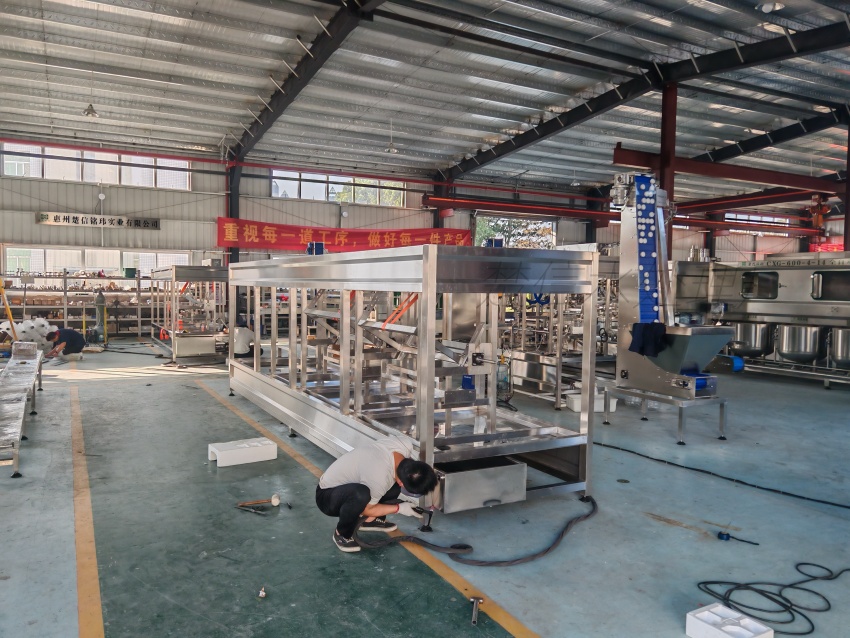
2. Operational Scenarios and Capacity Calculation
Capacity planning often presents a common pitfall for new deployments. A frequent error is converting bottle-per-hour ratings directly into total water volume without accounting for auxiliary consumption.
It is crucial to understand that you cannot simply convert the bottling line's bottles per hour into finished product water volume. You must also account for rinsing water usage, CIP cleaning cycles, equipment flushing, blending losses, peak buffering, and planned operating time. Typically, the first step is to calculate the finished product quantity per shift, then add process water and safety margins, checking whether the raw water tank and finished water tank can balance short-term fluctuations. Final calculations should be confirmed by project material balance.
The rated output capacity ranges from 200 to 1,800 bottles/hour based on 18.9 L bottles. However, this figure assumes stable conditions. Operations leads should verify:
- Bottle Geometry:*
- Variations in diameter and height affect conveyor speed and washing time.
- Cleaning Cycles:*
- Frequency of CIP impacts net operational hours.
- Peak Buffering:*
- Ensure the system handles demand spikes without bottlenecking.
3. Implementation Boundaries and Facility Integration
Successful deployment requires alignment between the filling line and the facility's environmental controls. The filling zone operates within a controlled environment where air quality directly impacts product safety.
Chuxin Mingwei’s systems are designed to integrate with cleanroom infrastructure. For more details on how to design the zoning and airflow for your facility, see our guide on water plant cleanroom process flow design zoning equipment. The filling line supports ISO Class 8 (100,000) environments, with options to upgrade to Class 7 (10,000). Key implementation boundaries include:
- Airflow Zoning:*
- Specific patterns prevent dust settlement on open bottle mouths.
- Pressure Differential:*
- Maintaining positive pressure prevents unfiltered air ingress.
- Service Scope:*
- The engagement covers design, manufacturing, installation, commissioning, and training, but excludes external civil works unless specified.
Conclusion
Selecting a bottled spring water production line requires moving beyond generic specifications to a site-specific engineering solution. By prioritizing the NF + UF process for mineral retention and integrating robust clean air support, Chuxin Mingwei delivers a system focused on long-term maintainability and operational stability. The goal is to engineer a production flow that respects the source water's integrity while meeting rigorous industrial standards.
For projects requiring precise capacity calculations or cleanroom layout planning, we recommend initiating a detailed consultation to map your facility constraints to our engineering capabilities.