
Electroplating Pure Water System Cost: Configuration Drivers, Budgeting Factors & Decision Guide
Who Needs an Electroplating-Grade Pure Water System?
Industrial clients in surface treatment, precision manufacturing, electronics plating, and specialized metal finishing require ultra-pure water to prevent contamination, ensure coating adhesion, and meet product quality standards. Unlike general industrial uses, electroplating processes demand water with very low ion content—typically achieving resistivity levels between 1 MΩ·cm and 18.2 MΩ·cm depending on application severity.
Chuxin Mingwei designs non-standard water treatment systems tailored to actual operational contexts. While our published offerings focus on bottled water production lines and cleanroom air solutions, the core engineering principles—especially dual-stage reverse osmosis (RO), ion exchange, and sterile delivery—apply directly to high-purity industrial water projects such as those serving electroplating facilities.
What Determines the Cost of an Electroplating Pure Water System?
There is no fixed price for an electroplating pure water system. Costs are driven by site-specific engineering parameters:
- Source water quality: Higher TDS, hardness, or organic load requires more robust pre-treatment (e.g., multi-media filtration, activated carbon, softening), increasing both initial cost and footprint.
- Target water specifications: Systems aiming for >10 MΩ·cm resistivity often combine dual-stage RO with mixed bed deionization or electrodeionization (EDI), which significantly affects component selection and control complexity.
- Production capacity: Rated output from 1,000 L/h to over 10,000 L/h influences pump sizing, membrane array count, and tank volume—all key cost variables.
- Automation and control: PLC-based intelligent control systems with HMI interfaces, real-time monitoring, and remote diagnostics add value but also cost, especially when integrated with plant-wide SCADA.
- Sterilization and storage: To prevent microbial regrowth, systems may include UV (254 nm) irradiation, ozone injection, and sanitary-grade CIP-cleanable storage tanks—features that enhance performance but increase configuration cost.
For example, a system built around a dual-stage RO deep purification process combined with ozone and UV dual sterilization—similar to configurations used in purified water bottling lines—can serve as a reliable base for moderate-to-high purity demands in electroplating rinse water applications .
How Configuration Choices Impact Budget and Performance
Choosing between different purification architectures involves trade-offs:
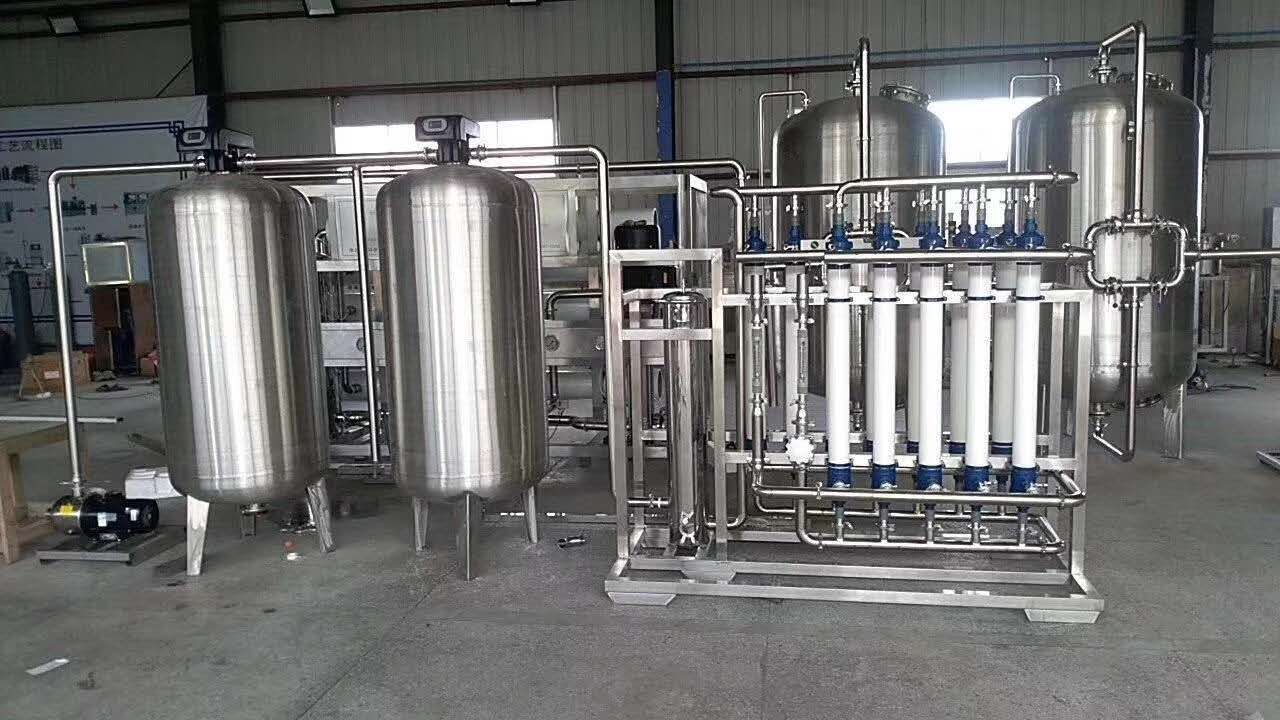
- A single-pass RO + mixed bed
- system offers lower upfront cost but requires periodic chemical regeneration.
- A dual-stage RO + EDI
- system has higher initial investment but enables continuous operation with minimal chemical use—ideal for stable, large-scale production environments.
- Adding H13 HEPA-grade air handling units
- to protect water transfer zones aligns with cleanroom integration practices seen in bottled water filling operations, reducing particulate risk during sensitive processes .
System boundaries also affect total cost. Projects requiring full turnkey delivery—including design, manufacturing, piping, electrical integration, commissioning, operator training, and after-sales support—will naturally exceed partial-supply quotes.
Implementation Boundaries and Realistic Expectations
It’s important to recognize that:
- Pricing cannot be standardized due to non-recurring engineering requirements.
- Final costs depend on confirmed water analysis reports, facility drawings, and utility availability.
- Lead times vary based on customization depth and component sourcing.
- Compliance with local environmental, safety, and discharge regulations must be verified separately.
As stated in internal documentation: "Price, capacity, water quality, and delivery time need to be confirmed per project" . This reflects our commitment to accuracy and transparency in commercial discussions.
Next Steps for Procurement Teams
If you're evaluating options for an electroplating pure water system:
- Collect representative raw water samples for laboratory testing.
- Define required flow rate, peak demand, and target water resistivity.
- Assess available space, power supply, drainage, and ventilation conditions.
- Clarify automation expectations and data logging needs.
- Contact us for a preliminary technical consultation—we can assess feasibility and outline a conceptual design before formal quotation.
We recommend starting with a scoped engineering review rather than seeking generic price lists, as meaningful budgeting begins with defined technical inputs.
Explore related resources: bottled water production line quotation], [RO [water treatment equipment price].