
RO System Selection for Barrelled Water: Diagnosing Single vs. Dual-Stage Based on Raw Water Conductivity
RO System Selection for Barrelled Water: Diagnosing Single vs. Dual-Stage Based on Raw Water Conductivity
The Core Technical Decision
For procurement managers and technical evaluation teams in the beverage and food sectors, the decision to deploy a single-stage versus dual-stage Reverse Osmosis (RO) system is often the most critical variable in designing a bottled purified water filling line. This choice directly dictates capital expenditure, energy consumption, membrane lifespan, and final product stability.
The primary diagnostic factor is not simply "water hardness" but rather the raw water conductivity and the specific target water standard required by local regulations or brand positioning. A mismatch here leads to either excessive operating costs (over-engineering) or failure to meet quality benchmarks (under-engineering).
Technical Principles: Selection Criteria
The Role of Raw Water Conductivity
According to industry engineering standards for industrial purification systems, the feed water quality determines the necessary purification depth:
- Single-Stage RO: Typically suitable when raw water conductivity is relatively low (e.g., municipal tap water with moderate salinity). It effectively removes dissolved solids to produce purified water meeting general drinking standards.
- Dual-Stage RO: Necessary when raw water conductivity is high (e.g., brackish groundwater, seawater intrusion areas, or highly mineralized sources). In these scenarios, a single pass cannot achieve the required resistivity without causing rapid membrane fouling or excessive concentrate waste.
Process Architecture and Product Alignment
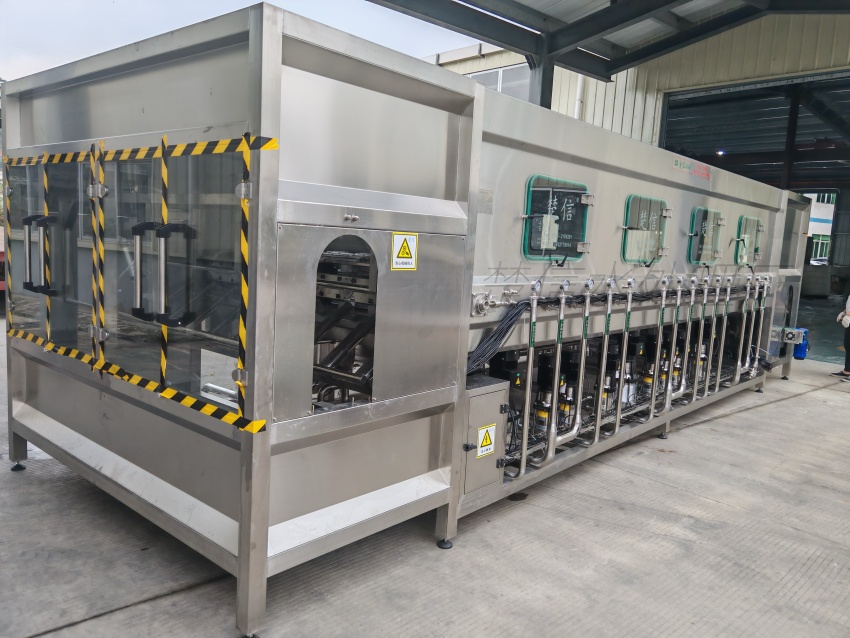
Chuxin Mingwei's Fully Automatic Bottled Purified Water Filling Production Line is engineered around this distinction. The system integrates a multi-media filtration and activated carbon pre-treatment stage followed by the core RO unit.
- Standard Configuration: For many regional projects, a two-stage RO deep purification process combined with ozone and UV sterilization (254 nm) ensures consistent purity. This aligns with the requirement for stable output regardless of seasonal fluctuations in source water.
- Capacity Matching: The rated capacity of these lines ranges from 200 to 2,500 bottles/hour, specifically optimized for 5 L, 11.3 L, and 18.9 L barrels. The RO configuration must be scaled to match this throughput while maintaining the necessary recovery rate.
Implementation Boundaries and Operational Risks
The Risk of Over-Sizing
Selecting a dual-stage system where a single-stage suffices increases initial investment and energy usage without proportional benefit. Conversely, under-sizing forces the system to operate at maximum pressure, accelerating membrane degradation and increasing maintenance frequency.
Integration with Clean Air Standards
Water treatment does not exist in isolation. For barrelled water filling cleanrooms, the air purification system must support the water line's hygiene requirements. Chuxin Mingwei designs Clean Air Purification Systems that integrate with the filling line, ensuring compliance with ISO Class 8 (100,000) standards, which can be upgraded to Class 7 if required. The airflow and pressure zoning are site-specific, based on the layout of the washing-filling-capping units.
Service Scope and Delivery
The delivery of these systems includes end-to-end engineering services:
- Design: Site-specific engineering based on actual source water analysis.
- Manufacturing: Custom fabrication of tanks, piping, and control panels.
- Installation & Commissioning: On-site setup and performance validation.
- Training: Operator training on RO maintenance, CIP (Clean-in-Place) procedures, and troubleshooting.
Selection Criteria Checklist for Technical Evaluators
Before initiating a project, evaluate the following parameters to determine the correct RO configuration:
| Parameter | Single-Stage RO Indication | Dual-Stage RO Indication |
|---|---|---|
| Raw Water Conductivity | Low to Moderate (< 500 µS/cm typical) | High (> 500 µS/cm or variable) |
| Target Purity | Standard Drinking Water | High-Purity / Strict Regulatory |
| Membrane Life Expectancy | Standard (2-3 years) | Extended (requires lower flux per stage) |
| Energy Consumption | Lower | Higher (due to second pump stage) |
| System Complexity | Simplified Control Logic | Advanced PLC/HMI Diagnostics |
Next Steps: From Diagnosis to Deployment
To ensure the selected bottled purified water equipment meets your facility's constraints, we recommend the following workflow:
- Source Water Analysis: Obtain a comprehensive water report including conductivity, TDS, pH, and microbial load.
- Site Survey: Verify space availability for the washing-filling-capping unit and tank farm.
- Technical Proposal: Request a customized design from our engineering team that maps the RO configuration to your specific water quality data.
- Validation: Review the proposed material balance and energy calculations before finalizing the contract.
Huizhou Chuxin Mingwei Industrial Co., Ltd. specializes in non-standard, site-specific solutions. We do not offer generic off-the-shelf packages; every system is engineered from actual source water quality and facility constraints to prioritize stability and long-term maintainability.
Conclusion
Choosing between single-stage and dual-stage RO for a barrelled water filling line is a technical decision rooted in raw water conductivity and regulatory targets. By aligning the purification process with your specific source data, you optimize both CAPEX and OPEX while ensuring consistent product quality.
CTA Text: Contact our engineering team today to submit your water analysis report and receive a preliminary RO configuration proposal tailored to your 18.9L production needs.
---
Key Points Summary
- Decision Driver: Raw water conductivity and target purity standards dictate the need for single vs. dual-stage RO.
- Product Fit: Fully automatic lines support 5L, 11.3L, and 18.9L barrels with capacities up to 2,500 bottles/hour.
- Process Depth: Dual-stage RO is recommended for high-conductivity sources to prevent membrane fouling and ensure stability.
- Integration: Water treatment systems are designed to integrate seamlessly with ISO Class 8 clean air solutions.
- Service Model: End-to-end delivery includes design, manufacturing, installation, and operator training.
Final Recommendation
Proper RO system sizing prevents operational bottlenecks and ensures the longevity of your bottled purified water filling line. Whether your project requires a streamlined single-stage solution or a robust dual-stage deep purification system, the decision must be grounded in verified source water data. Partnering with an experienced manufacturer like Chuxin Mingwei ensures that your water treatment infrastructure is not just a piece of equipment, but a reliable foundation for your entire production line.
Contact Us to discuss your specific water quality profile and production goals.