
How to choose large-container water production: selection, rollout and support checklist
Who This Guide Is For
This article addresses procurement managers, plant engineers, and operations leads evaluating or designing a large-container water production line for 10L, 15L, or 18.9L (5-gallon) returnable or single-use barrels. Unlike small-bottle PET lines, large-container production involves returnable barrel logistics, intensive multi-stage washing, and stricter cleanroom zoning — all of which shape equipment selection, facility layout, and long-term operating costs.
If your project involves 3-gallon or 5-gallon barrelled purified water, spring water, or mineral water, the process flow below reflects the engineering logic Chuxin Mingwei applies when designing site-specific filling systems.
The Standard Process Chain for Large-Container Water Production
A complete large-container line follows this sequence:
Empty Barrel Recovery → Inspection & Sorting → Decapping → External Brushing → Internal Brushing → Multi-Stage Washing & Disinfection → Final Rinse with Product Water → Filling → Cap Placement & Pressing → Visual Inspection → Labeling/Sleeving → Coding → Bagging → Conveying to Warehouse
Each stage serves a specific contamination-control or quality-assurance function. Skipping or shortening any stage introduces microbial or chemical risk that compounds downstream.
Stage 1: Barrel Recovery, Inspection & Sorting
Returnable barrels arrive from distribution with varying levels of external contamination, residual water, and potential damage. The first operational step is manual or semi-automated sorting:
- Visual inspection for cracks, deformation, or embedded debris.
- Odor checks for barrels that stored non-water substances.
- Segregation of barrels requiring heavy rework versus standard cleaning.
Barrels that fail inspection are removed from the production loop. This stage is labor-intensive but prevents contaminated or damaged containers from entering the automated wash system, where they could compromise the entire batch.
Stage 2: Decapping & External Brushing
An automatic decapping machine removes the used cap and tamper-evident seal. Following decapping, an external brushing unit scrubs the barrel exterior — particularly the neck, handle, and base — to remove dirt, labels, and biofilm accumulated during storage and transport.
Selection variables for this stage include barrel diameter range, throughput synchronization with downstream wash stations, and brush material compatibility with PC or PET barrel surfaces.
Stage 3: Internal Brushing & Multi-Stage Washing
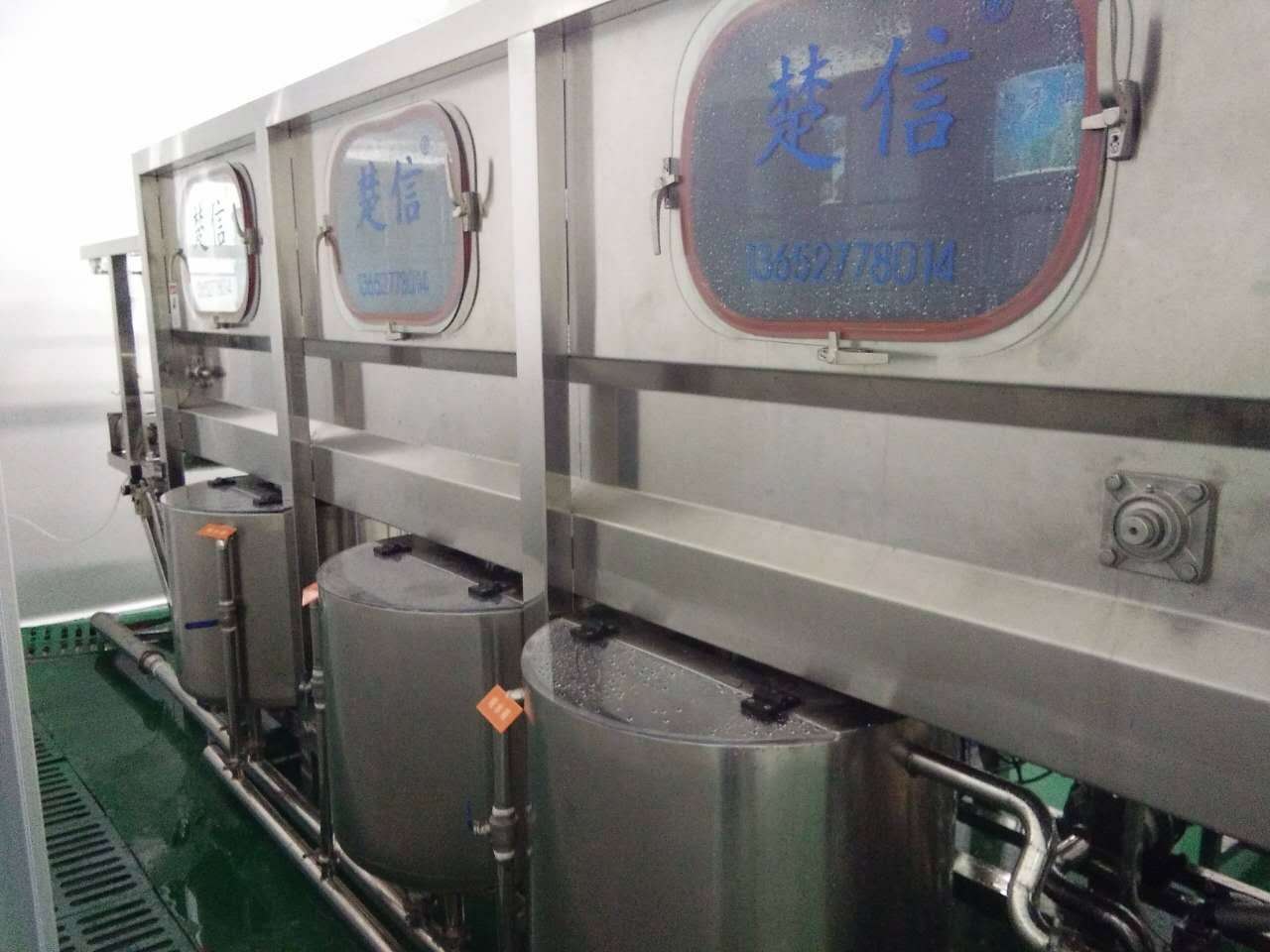
This is the most critical contamination-control stage in the entire line. A multi-station barrel washer typically includes:
- Pre-rinse with recycled water to loosen internal residue.
- Alkaline detergent wash at elevated temperature to break down biofilm and organic deposits.
- Acid or sanitizer rinse to address mineral scale and microbial load.
- Multiple clean-water rinses to remove all detergent and chemical residues.
- Final rinse with finished product water to ensure no foreign substances remain before filling.
The number of wash stations, contact time per station, water temperature, and chemical concentration are all configurable based on the contamination profile of your returnable barrels. Lines serving markets with high barrel turnover and consistent return quality may require fewer stations, while lines handling barrels from dispersed or uncontrolled distribution channels need more aggressive wash configurations.
Stage 4: Disinfection — Ozone and UV
After washing, barrels and the product water itself require disinfection. Two complementary methods are standard:
- Ozone (O₃): Effective for both barrel interior sanitization and product water treatment. Ozone decomposes into oxygen, leaving no chemical residue. However, dosing, contact time, and off-gas management must be carefully controlled to avoid bromate formation or operator exposure.
- Ultraviolet (UV) at 254 nm: A physical disinfection method applied to product water before filling. UV effectiveness depends on water clarity, flow rate, lamp intensity, and sleeve cleanliness. It provides no residual disinfection, so it must be paired with ozone or maintained in a closed, sanitary loop.
For barrelled purified water lines, a dual-stage RO system combined with ozone and UV provides robust microbial control while meeting regulatory conductivity requirements.
Stage 5: Filling & Capping
The wash-fill-seal integrated machine (also called a 3-in-1 or 5-in-1 monoblock for barrelled water) performs final rinse, volumetric filling, and cap application in a single enclosed unit. This integration minimizes barrel exposure to ambient air between washing and sealing.
Key engineering parameters:
- Filling accuracy: Typically within ±2 mL for volumetric systems.
- Capping pass rate: Target ≥99.6% for snap-cap or screw-cap applications.
- Cap sterilization: Caps pass through a UV or ozone sterilization tunnel before placement.
- Compatibility: The machine must accommodate your specific barrel mouth diameter, cap type (snap-on, screw, or press-fit), and barrel material (PC or PET).
Production capacity for large-container lines typically ranges from 200 to 1,800 barrels per hour, configurable by adding or removing filling heads (commonly 4 to 12 heads).
Stage 6: Inspection, Labeling, Coding & Bagging
After sealing, barrels pass through:
- Light inspection (Light Inspection): Operators or vision systems check fill level, cap alignment, and particulate presence.
- Labeling or sleeve application: Heat-shrink sleeves or adhesive labels are applied, with shrink tunnel parameters tuned to barrel geometry.
- Inkjet or laser coding: Production date, batch number, and expiry are printed on the cap or label.
- Barrel bagging: An automatic barrel-wrap packaging machine applies a protective PE or PP film sleeve over the entire barrel, using servo positioning and vacuum-assisted handling to achieve consistent placement. This stage protects the barrel during storage and distribution.
Stage 7: Conveying & Palletizing
Finished barrels move via chain or roller conveyors to the staging area. Depending on throughput and warehouse layout, an automatic palletizer stacks barrels onto pallets in programmed layer patterns. Palletizing selection should account for barrel weight (approximately 19 kg for a full 18.9L barrel), pallet dimensions, stacking height limits, and forklift traffic patterns.
Water Treatment: The Upstream Foundation
The filling line is only as reliable as the water treatment system feeding it. For large-container purified water, the typical treatment chain includes:
- Multi-media filtration: Reduces suspended solids and turbidity.
- Activated carbon filtration: Adsorbs residual chlorine, organics, and odor compounds — protecting downstream RO membranes.
- Water softening: Ion exchange reduces calcium and magnesium hardness to prevent membrane scaling.
- Precision filtration (5μm or finer): Final particulate guard before RO.
- Dual-stage reverse osmosis (RO): Removes dissolved salts, organics, and microorganisms to achieve target conductivity.
- Ozone + UV disinfection: Final microbial barrier before the sterile storage tank.
For spring water or mineral water, the treatment approach differs fundamentally. RO is generally avoided to preserve naturally occurring minerals. Instead, a combination of multi-media filtration, ultrafiltration (UF), and controlled disinfection is used — with the exact configuration determined by source water analysis and target product standards.
Cleanroom & Environmental Control
The filling zone for large-container water requires controlled air quality. Standard configurations target ISO Class 8 (100,000 class) cleanliness, with options to upgrade to Class 7 (10,000 class) for higher-risk products or stricter regulatory environments.
Cleanroom design encompasses:
- HEPA filtration (H13 grade) on supply air.
- Positive pressure zoning to prevent ingress of unfiltered air.
- Airflow and duct routing engineered for the specific room geometry.
- Personnel and material flow separation: Air showers, pass-through boxes, and dedicated gowning protocols.
- Temperature, humidity, and air-change monitoring with PLC-based control.
The cleanroom boundary typically encompasses the wash-fill-seal machine, cap sterilization, and the immediate post-fill inspection zone. Packaging, coding, and palletizing operate outside the cleanroom.
Selection Variables That Shape Your Line Configuration
When specifying a large-container water production line, the following inputs determine equipment selection, layout, and investment:
| Variable | Impact on Line Design |
|---|---|
| Barrel material (PC vs. PET) | Wash temperature limits, brush selection, cap type |
| Barrel sizes (10L, 15L, 18.9L) | Machine changeover requirements, conveyor width |
| Returnable vs. single-use | Presence or absence of decapping, external brushing, and multi-stage wash |
| Source water quality | Treatment chain complexity, membrane selection, chemical dosing |
| Target production capacity | Number of filling heads, wash station count, conveyor speed |
| Facility footprint | Line layout (straight vs. U-shape), cleanroom dimensions |
| Automation level | Manual barrel loading vs. automatic de-palletizing and re-palletizing |
| Regulatory environment | Cleanroom class, documentation requirements, validation protocols |
Operational Boundaries & Common Risks
Detergent residue: Inadequate rinse cycles after alkaline or acid washing can leave chemical traces in the barrel. Final rinse water quality and volume must be validated.
Cap contamination: Caps stored in uncontrolled environments introduce microbial load. Cap sterilization (UV or ozone tunnel) is non-negotiable, even if caps arrive in sealed packaging.
Ozone off-gas: Excess ozone in the filling area poses operator health risks and can oxidize barrel materials. Off-gas destruct units and ventilation must be engineered into the system.
Biofilm in recirculation loops: Finished water storage tanks and distribution piping require periodic CIP (Clean-in-Place) and sanitization. Stagnant loops are a primary source of post-treatment contamination.
Barrel degradation: PC barrels have a finite service life. Repeated washing at high temperature and alkaline pH gradually degrades the material. A barrel lifecycle tracking and retirement protocol is essential.
Next Steps for Your Project
A large-container water production line is not a catalog product — it is an engineered system shaped by your source water, barrel type, capacity target, facility constraints, and regulatory requirements. The process flow described above represents the standard architecture; your specific configuration will differ based on site conditions.
To move forward, prepare the following inputs for a solution consultation:
- Source water test report (or municipal water quality data).
- Target product standard (purified water, spring water, or mineral water).
- Barrel specifications (material, sizes, mouth type, returnable or single-use).
- Target hourly capacity and shift pattern.
- Available facility dimensions and utility conditions (power, drainage, compressed air).
With these inputs, a tailored process design — including equipment selection, workshop layout, piping and electrical schematics, and cleanroom zoning — can be developed for your review.