
New Barrel vs Recycled Barrel Washing: Process Differences and Equipment Configuration Guide
Who This Guide Is For
Procurement managers, plant engineers, and digital project leads in beverage, food, and pharmaceutical manufacturing — especially those evaluating or commissioning a barrelled water filling line (e.g., 3-gallon or 5-gallon / 11.3 L or 18.9 L) in Huizhou or across China. You’re likely comparing quotations, reviewing technical proposals, or preparing internal feasibility assessments — and need to distinguish what’s essential from what’s optional in barrel washing design.
Why Barrel Origin Matters — Not Just Capacity or Speed
Unlike bottled water lines where empty PET bottles are typically single-use and uniform, barrelled water production relies on two distinct material streams:
- New (virgin) barrels, usually made of food-grade polycarbonate or PETG, arrive sealed and factory-clean — but may carry mold release agents, dust, or static residue;
- Recycled (returnable) barrels, used multiple times across distribution cycles, accumulate biofilm, mineral scale, label adhesive, external grime, and potential microbial contamination at the neck and interior surface.
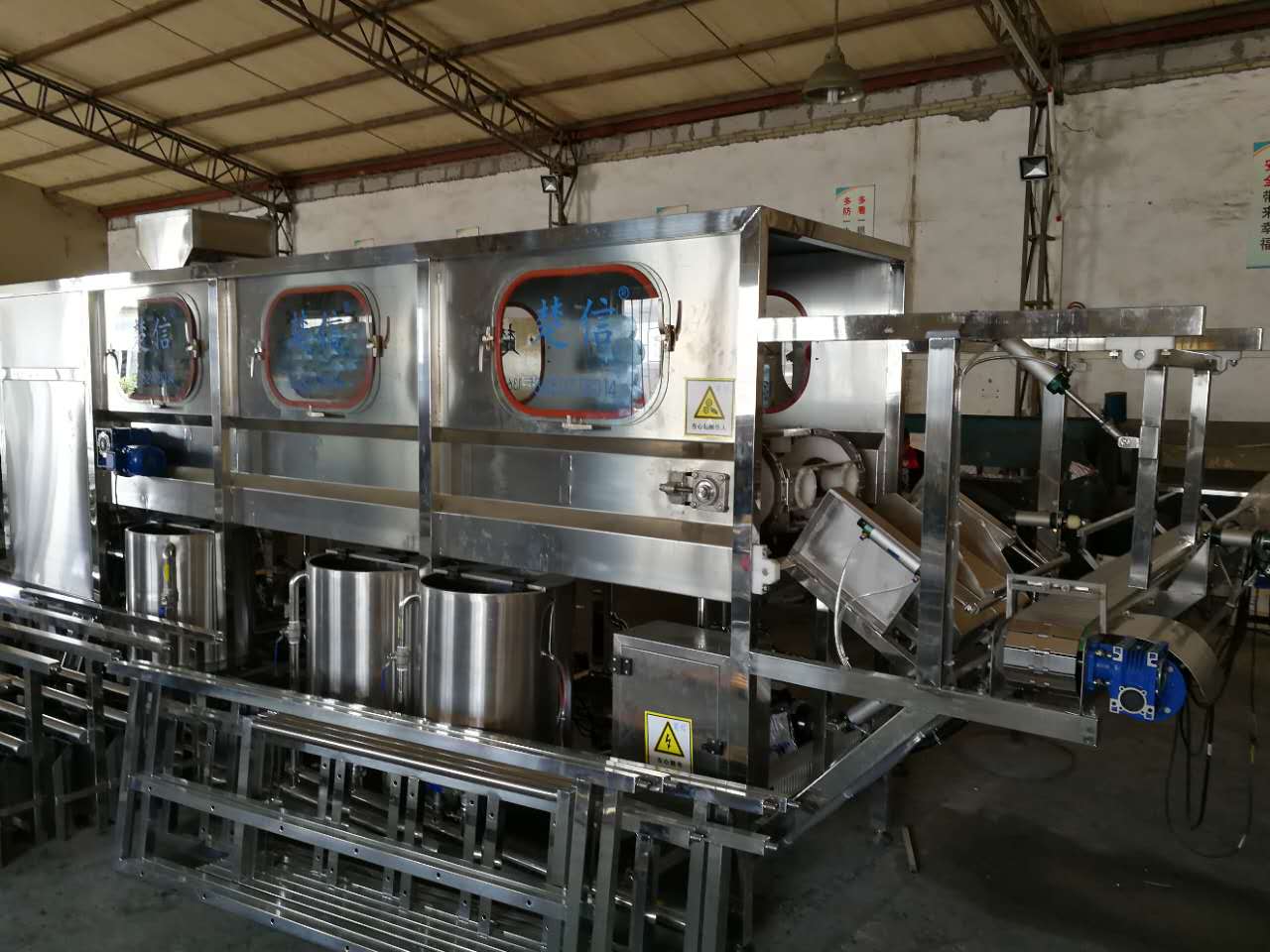
This difference isn’t academic — it directly determines the minimum required process sequence, equipment module selection, and validation boundaries for your line. As confirmed in Chuxin Mingwei’s implementation practice (`FAQ-BARREL-02`), recycled barrels demand a full-cycle workflow: inspection → cap removal → external brushing → multi-stage internal washing & disinfection → high-purity rinse → air drying. New barrels typically skip cap removal, external brushing, and extended disinfection — but still require controlled rinsing and quality-assured drying to meet ISO Class 8 cleanroom integration standards.
Core Process Differences — A Side-by-Side Comparison
| Step | New Barrel Washing | Recycled Barrel Washing |
|---|---|---|
| Pre-wash inspection | Visual check only; no cap removal needed | Cap removal + visual + tactile inspection for cracks, deformation, residual sealant |
| External cleaning | Optional light air blow-off or wipe-down | Mandatory rotary brush + detergent spray + high-pressure rinse |
| Internal cleaning | Single-stage purified water rinse (≥15 s contact time) | Multi-stage: alkaline wash → acid rinse → chlorine dioxide or ozone disinfection → double purified water rinse |
| Rinse water source | Treated product water (RO/NF grade) | Dedicated pre-treated rinse loop (multi-media + activated carbon + UF) to avoid cross-contamination |
| Drying method | HEPA-filtered hot air (integrated with clean air system) | Dual-zone hot/cold air + vacuum assist to remove residual moisture from crevices |
️ Key boundary note: Chuxin Mingwei’s barrel washing units are not modular plug-and-play. Configuration is locked at engineering design stage — based on your confirmed barrel type, supplier certification, local water hardness, and facility layout. Retrofitting a recycled-barrel module onto a new-barrel line post-installation is not feasible without full re-engineering.
Equipment Implications — What Changes in Your Line Specification
When specifying a barrelled water filling production line, the choice between new and recycled barrels affects three core subsystems:
- Washing Unit Architecture
- New barrel lines use compact, linear rinse-dry stations — often integrated into the main filling monoblock.
- Recycled barrel lines require a dedicated, multi-station carousel or inline tunnel with independent chemical dosing, temperature control, and CIP capability.
- Water Treatment Integration
- Recycled barrel washing demands a separate pre-treatment train (beyond the main RO/NF system) to protect membranes from organic load and chlorine residuals. This is non-negotiable for stable operation (`JR-WATER-01`).
- Clean Air System Sizing
- Drying zones for recycled barrels consume significantly more airflow (up to 20,000 m³/h vs. 3,000–5,000 m³/h for new barrels). Your ISO Class 8 cleanroom design must account for this load — including duct routing, pressure zoning, and H13 HEPA filter bank sizing (`Clean Air Purification Systems`, spec: airflow range 1,500–20,000 m³/h).
Next Steps — Before You Finalize Your Technical Agreement
- Confirm barrel origin and certification: Request test reports from your barrel supplier — especially for extractables, leachables, and sterilization compatibility.
- Define ‘clean’ explicitly: Agree on measurable acceptance criteria — e.g., total viable count (TVC) ≤10 CFU/barrel post-rinse, residual chlorine <0.1 ppm, particle count ≤20/ft³ (≥0.5 µm).
- Validate scope alignment: Ensure your quotation includes all washing-related utilities (chemical storage, waste neutralization, heat recovery), not just mechanical units.
- Schedule joint process review: Chuxin Mingwei offers pre-order engineering workshops to map your actual barrel logistics, water quality data, and facility constraints — avoiding scope gaps during commissioning.
Conclusion
Choosing between new and recycled barrel washing isn’t about cost trade-offs alone — it’s about matching process rigor to real-world contamination vectors. A recycled-barrel line isn’t “more advanced”; it’s more constrained, requiring deeper integration across water treatment, automation, and clean air systems. The right configuration starts with honest input — not assumptions. Let your actual barrels, not generic specs, drive the design.
Ready to Align Your Barrel Washing Design With Real Operational Needs?
Request a free process alignment workshop — where Chuxin Mingwei engineers review your barrel samples, source water report, and facility layout to define exact washing specifications, utility loads, and delivery milestones.