
New vs. Reused Barrel Cleaning in Barrelled Water Filling Lines
When designing or upgrading a barrelled water filling line, the selection between new and reused barrels is not a simple cost decision—it defines the entire cleaning process and system architecture. The two options require fundamentally different equipment setups, operational controls, and maintenance protocols.
New barrels, typically made from virgin HDPE, arrive sealed and free of prior contaminants. Their cleaning process is minimal: a low-pressure rinse to remove dust or transport residues, followed by disinfection via UV or ozone. No chemical sanitization, external scrubbing, or high-pressure internal flushing is needed. Systems configured for new barrels eliminate wash stations, chemical dosing units, and wastewater recovery systems, reducing capital cost and operational complexity.
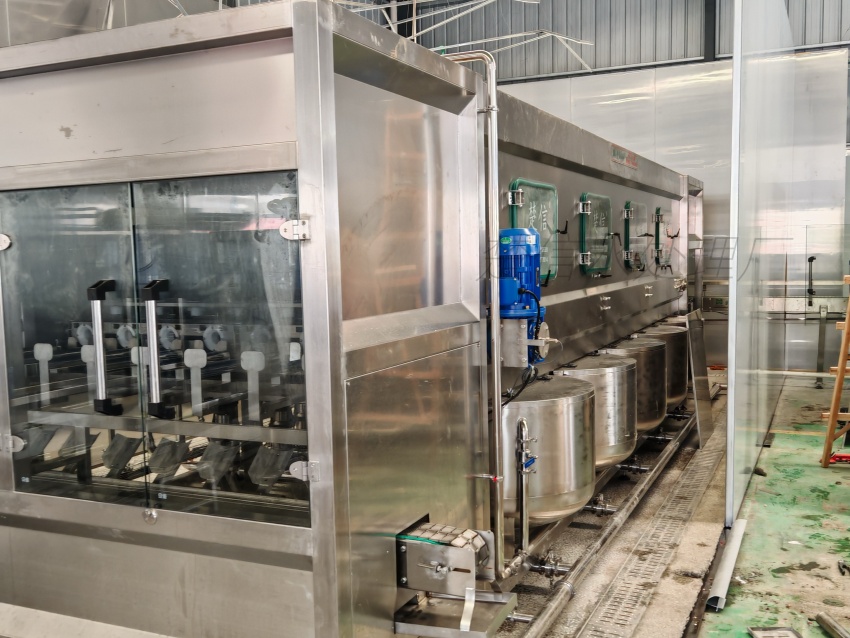
Reused barrels, however, enter the line with residual caps, labels, biofilm, and organic matter. Their cleaning cycle is multi-stage and tightly controlled: cap removal, external brushing, internal high-pressure jet washing, chemical sanitization (e.g., peracetic acid or chlorine-based solutions), thorough rinsing, and air-drying. Each step must be validated to prevent cross-contamination and meet food-grade hygiene standards. Systems for reused barrels require dedicated wash zones, chemical circulation tanks, drainage capacity for high-volume wastewater, and air-knife drying to ensure dryness before filling.
The equipment configuration must align with the barrel type. A system designed for reused barrels includes:
- External rotating brushes for label and dirt removal
- High-pressure internal nozzles capable of penetrating residue
- Precise chemical dosing and circulation control
- Separate rinse and drain zones to avoid recontamination
- Air-knife drying to eliminate moisture
Systems for new barrels omit these components. A simplified rinse and disinfection stage is sufficient.
Operational risks differ significantly. Reused barrel lines introduce:
- Higher labor dependency for inspection and handling
- Increased wastewater volume, requiring larger drainage and treatment infrastructure
- Greater risk of microbial contamination if cleaning validation is inconsistent
- Barrel degradation over cycles, leading to cracks or seal failure that compromise sterility
New barrel systems reduce these variables. They are preferred in facilities with strict hygiene controls, such as pharmaceutical-grade water production or export-focused operations, where consistency and compliance burden must be minimized.
Decision factors include:
- Regulatory environment: Formal audits or export certifications favor new barrels for lower validation complexity.
- Production volume: Higher throughput benefits from the consistent cycle time of new barrels.
- Facility layout: Limited space favors new barrel systems, which require fewer wash stations.
- Water quality: High-mineral or high-TDS source water increases scaling risk in reused barrel wash lines.
- Maintenance capability: Reused barrel systems require trained staff for chemical handling, nozzle maintenance, and cleaning logs.
The barrel type must be defined before equipment specification. Choosing incorrectly leads to over-engineering, under-capacity, or safety risks. The cleaning process determines the air purification load, wastewater capacity, PLC control logic, and HMI monitoring points.
Chuxin Mingwei designs every filling line based on actual barrel type, source water, production volume, and facility constraints. We do not offer generic configurations. Equipment lists must reflect the specific cleaning steps required for your chosen barrel type—otherwise, the system will not perform as intended during commissioning or operation.