P0 Priority FAQ Guide: What Procurement Teams Need to Verify Before Finalizing a Bottled Water Filling Line Project
Why This Guide Exists: A Real-World Scenario
A beverage plant in Guangdong paused its RFP process after discovering that two shortlisted suppliers had omitted critical assumptions in their proposals: one assumed municipal-grade feed water (while the site used deep-well spring water), and another quoted 2,000 bottles/hour without accounting for CIP downtime or bottle changeover time. The result was a delay in commissioning and unplanned retrofitting of pre-filtration stages.
For procurement managers, operations leads, and digital project teams in beverage, food, pharmaceutical, electronics, and industrial sectors — especially those new to turnkey water filling projects — ambiguity in scope, deliverables, and handover boundaries creates real schedule, cost, and compliance risk.
Chuxin Mingwei’s P0 Priority FAQ framework addresses exactly this: four foundational questions that must be answered before final technical review or contract signature. These are not generic FAQs — they’re operational checkpoints derived from recurring gaps observed across installations since 2020.
P0 FAQ #1: Is the water treatment design matched to your actual source water, not a generic standard?
What to verify: Your proposal must reference measured lab reports (not just ‘typical spring water’ or ‘municipal supply’) for turbidity, iron/manganese, hardness, TOC, and microbiological load. Chuxin Mingwei’s bottled spring water lines (e.g., ID 60) use dual-membrane NF + UF specifically to retain minerals while removing pathogens — but only if raw water data informs membrane selection and pretreatment staging.
Boundary alert: RO-based purified water lines (ID 59) require stricter feed water control. If your source has detectable free chlorine or elevated iron, additional activated carbon or antiscalant dosing must be explicitly scoped — and verified in the P&ID package.
P0 FAQ #2: Does the rated output capacity reflect real-world operating conditions — not theoretical peak?
What to verify: Look beyond “200–2,500 bottles/hour”. Ask for the capacity calculation sheet, which must include:
- Bottle size & material (e.g., 18.9 L PET vs. 5 L HDPE)
- Planned shift duration and scheduled maintenance windows
- CIP cycle frequency and duration
- Bottle changeover time (e.g., switching between 18.9 L and 11.3 L formats)
Chuxin Mingwei’s specification sheets (e.g., ID 59, ID 60) state capacity by bottle size — not as a single range — because flow dynamics, valve response, and rinsing efficiency vary significantly across formats.
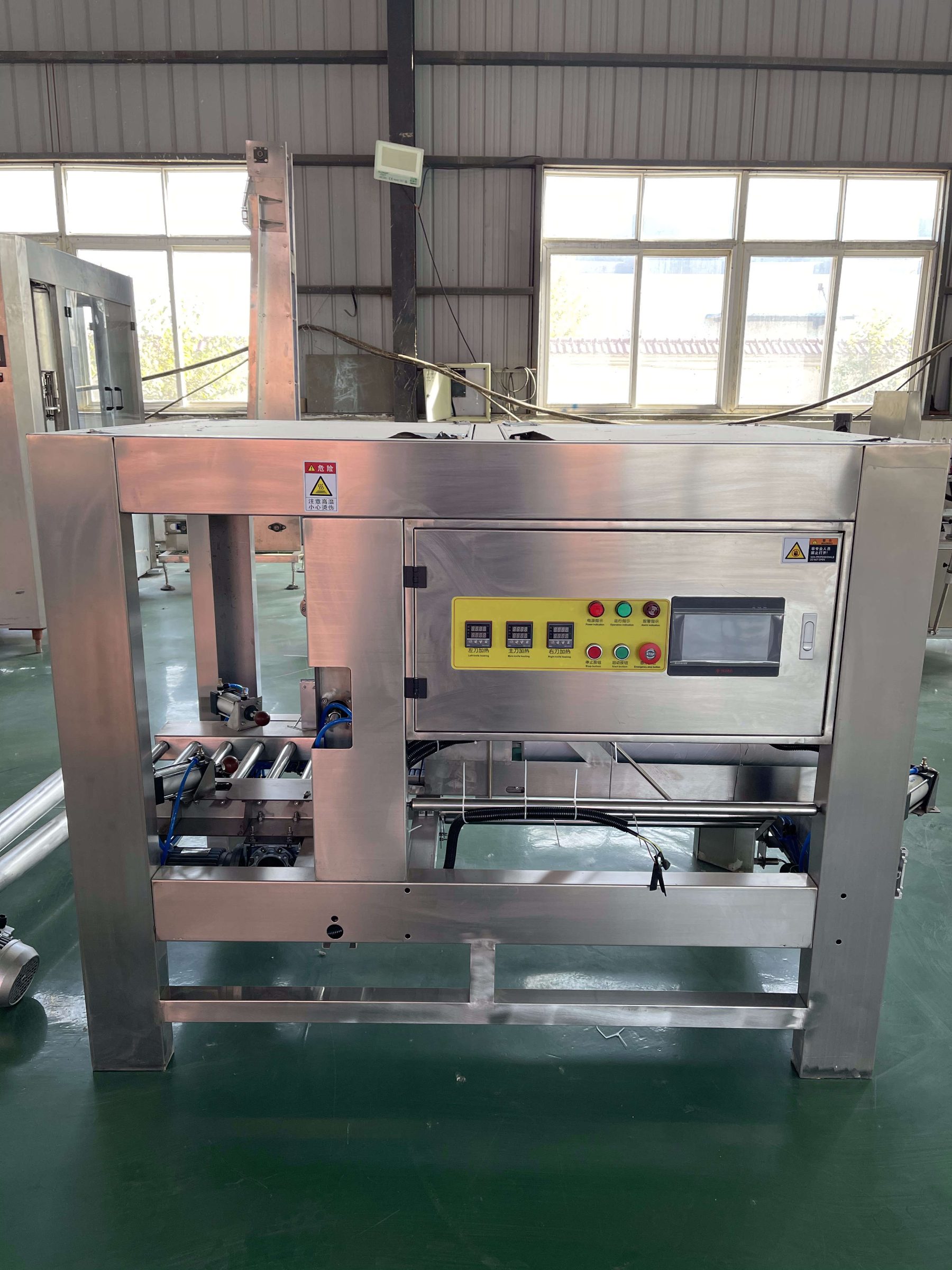
P0 FAQ #3: Is cleanroom air system integration defined by ISO class, airflow path, and pressure zoning — not just ‘HEPA filter included’?
What to verify: Clean air systems (ID 58) are engineered, not selected from catalog. Confirm that your proposal includes:
- Site-specific duct routing and static pressure loss calculations
- Differential pressure mapping between prep, filling, and capping zones
- H13 HEPA filtration with differential pressure monitoring
- PLC + HMI interface tied to your main line control system (not standalone)
ISO Class 8 (100,000) is the baseline — but upgrading to Class 7 requires re-engineering airflow volume (1,500–20,000 m³/h range), not just swapping filters.
P0 FAQ #4: What exactly is covered — and not covered — in after-sales support during Year 1?
What to verify: Chuxin Mingwei’s post-installation support includes operator training, remote diagnostics, and parts warranty — but excludes:
- Consumables (ozone lamps, UV sleeves, prefilter cartridges)
- Third-party utility failures (e.g., unstable compressed air pressure or voltage spikes)
- Modifications requested post-commissioning (e.g., adding a secondary labeling station)
All exclusions must appear in Section 7 (“Service Boundaries”) of the technical agreement — not buried in general terms.
Next Steps: How to Use This Checklist
- Download our bottled water production line quotation template — pre-filled with P0 verification fields.
- Cross-check your current supplier proposal against these four points. Flag any missing documentation or ambiguous wording.
- Request clarification — not just ‘yes/no’, but supporting evidence: lab reports, capacity calc sheets, duct layout sketches, and service boundary annexes.
Projects that pass all four P0 checks move to commissioning with predictable execution. Those missing even one item typically require additional alignment before proceeding.
For immediate validation of your current proposal, contact our Technical Procurement Support team — we’ll conduct a no-cost scope alignment review within 48 business hours.