Purified Water Bottling Machine Process: Failure Points, Operating Logic & Corrective Actions
Where Purified Water Bottling Lines Actually Fail
Most technical discussions about the purified water bottling machine process focus heavily on reverse osmosis performance. In practice, RO membrane efficiency is rarely the root cause of product quality failures or production downtime. The failures that cost beverage and food manufacturers the most — microbial contamination, inconsistent fill volumes, cap seal defects, and batch rejections — typically originate downstream of the purification stage.
This article dissects the purified water bottling machine process from a failure-diagnosis perspective. It is written for procurement managers, operations leads, and engineering teams evaluating or troubleshooting bottled purified water production lines for 5 L, 11.3 L, and 18.9 L (5-gallon) formats.
---
The Core Process Chain — And Where It Breaks
A standard purified water bottling process follows this sequence:
Raw water → Pre-treatment → Precision filtration → Two-stage RO purification → Sterilization (ozone + UV 254 nm) → Product water storage/circulation → Container washing → Filling and capping → Inspection → Packaging
Each stage has specific failure modes. Below, we examine the stages where problems most frequently surface and explain the operating logic behind corrective actions.
Failure Point 1: Sterilization Imbalance Between Ozone and UV
Purified water requires deep sterilization after RO treatment. The typical configuration pairs ozone generation with ultraviolet (254 nm) sterilization. However, these two methods behave differently and must be balanced carefully.
How it fails:
- Ozone provides residual disinfection through the storage and circulation loop, but excessive dosing creates off-taste, accelerates seal degradation, and generates bromate if source water contains bromide.
- UV sterilization is a physical process with no residual effect. Its effectiveness drops when water turbidity increases, flow rates exceed design parameters, lamp intensity decays, or quartz sleeves accumulate fouling.
Corrective action:
- Design ozone contact time and concentration based on actual product water volume and circulation loop length — not generic dosing tables.
- Position UV units at the point closest to filling to eliminate recontamination risk from storage tanks and circulation piping.
- Build monitoring protocols around ozone residual concentration at the filling valve and UV dose delivery (mJ/cm²), not just equipment run-time.
Failure Point 2: Container Washing Is the Real Bottleneck
For returnable 18.9 L barrel formats, container hygiene is the single largest contamination vector. The barrel washing sequence — cap removal, sorting, external brushing, internal brushing, multi-stage washing and disinfection, final rinse with product water — is far more complex than the filling step itself.
How it fails:
- Returned barrels carry variable contamination loads: residual biofilm, detergent carryover, environmental debris, and damaged barrel mouths that prevent proper sealing.
- Inadequate sorting allows heavily contaminated or structurally compromised barrels to enter the washing line, overwhelming downstream disinfection capacity.
- Detergent residue from internal brushing stages contaminates the final product if rinse cycles are shortened to increase throughput.
Corrective action:
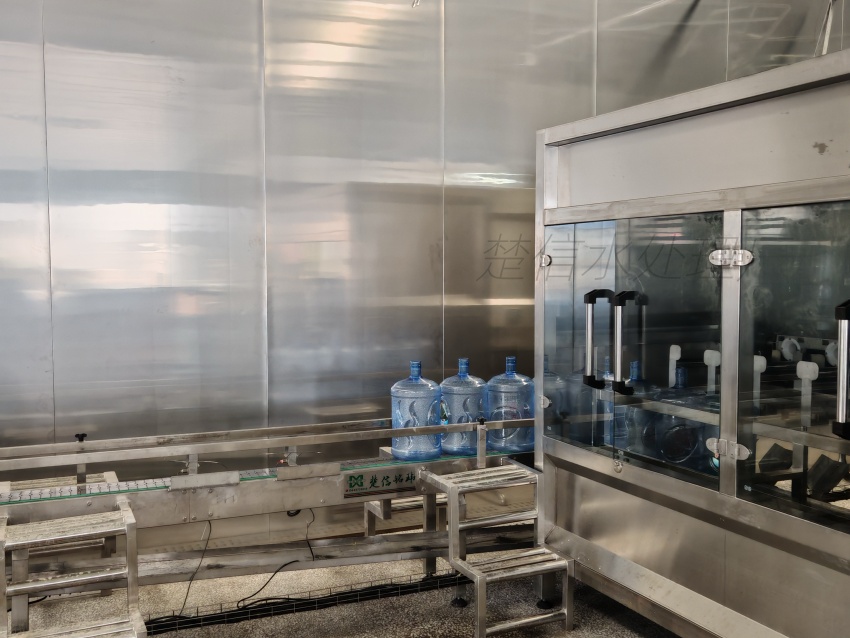
- Treat barrel sorting and inspection as a quality gate, not a logistics step. Remove barrels with visible damage, persistent odor, or deformed mouths before they enter the washer.
- Validate that the final rinse stage uses product-grade purified water — not pre-treated or municipal water — to eliminate recontamination at the last contact point.
- Match the number of washing and disinfection stations to the actual contamination profile of your returnable barrel pool, not to a theoretical minimum.
For single-use bottled formats (5 L, 11.3 L), the washing-filling-capping monoblock (three-in-one machine) reduces intermediate conveyance and exposure. The critical variable here is the transition time between rinsing and filling — and whether the rinse medium itself meets purified water standards.
Failure Point 3: Filling Environment and Secondary Contamination
Even with correctly purified water and thoroughly washed containers, the filling environment can reintroduce microbial contamination. This is where clean air systems become a process-critical component, not an optional add-on.
How it fails:
- Filling zones operating without controlled airflow and positive pressure allow airborne particulates and microorganisms to settle into open containers during the fill cycle.
- HVAC systems designed for general factory comfort — rather than ISO Class 8 (100,000) cleanroom compliance — cannot maintain the particle count and microbial limits required for purified water filling.
- Duct routing and pressure zoning that do not account for the specific layout of the filling line create dead zones where contaminated air accumulates.
Corrective action:
- Engineer the clean air system around the actual filling line layout: airflow direction should move from the highest-cleanliness zone (filling valve area) outward, with positive pressure maintained throughout the filling room.
- Specify H13 HEPA filtration as the terminal filter stage, with pre-filtration stages sized to protect HEPA filter life based on local ambient air quality.
- Design the system for ISO 14644-1 Class 8 compliance as a baseline, with a clear upgrade path to Class 7 (10,000) if product standards or regulatory requirements tighten.
---
Equipment Configuration Logic: Matching Capacity to Reality
A common procurement mistake is specifying equipment based on peak theoretical output rather than sustainable operational capacity. For Chuxin Mingwei's fully automatic bottled purified water filling lines, rated capacity ranges from 200 to 2,500 bottles per hour depending on format and configuration. However, the number that matters for your operation is the sustained throughput after accounting for:
- Format changeover time — switching between 5 L, 11.3 L, and 18.9 L bottles requires mechanical adjustments and validation runs.
- Upstream purification recovery rate — two-stage RO systems produce reject water; your raw water supply must exceed the filling line's consumption rate by the system's recovery ratio.
- Capping pass rate — a capping pass rate of ≥99.6% means that at 2,500 bottles/hour, approximately 10 bottles per hour require manual intervention or rejection.
- Planned maintenance windows — RO membrane cleaning (CIP), UV lamp replacement, and ozone generator servicing all require line stoppages.
Selection guideline: Specify your line for 75–80% of nameplate capacity as your sustainable daily output target. Use the remaining headroom for demand surges, not as your baseline planning number.
---
Operational Boundaries: What the Process Cannot Compensate For
The purified water bottling machine process is an engineered system with defined boundaries. Understanding these limits prevents costly misapplications:
| Boundary | Implication |
|---|---|
| Raw water quality variability | Pre-treatment design must be based on worst-case seasonal water quality, not average conditions. A sudden spike in turbidity or TDS can overwhelm pre-filtration and damage RO membranes. |
| RO is not a standalone solution | RO removes dissolved solids but does not address all microbial risks. Post-RO sterilization (ozone + UV) and storage loop hygiene are equally critical. |
| Product water storage is a risk zone | Even perfectly purified water degrades in storage if tanks, piping, and circulation pumps are not designed for sanitary service with continuous recirculation and residual disinfection. |
| Personnel and material flow | Cleanroom integrity depends on controlled access. Air showers, pass-through hatches, and gowning protocols are part of the filling process, not separate facility concerns. |
---
Implementation Sequence for New or Upgraded Lines
For teams planning a new purified water bottling line or upgrading an existing one, the following sequence reduces integration risk:
- Source water analysis — Conduct comprehensive raw water testing across multiple seasons. This determines pre-treatment configuration and RO membrane selection.
- Capacity and format definition — Lock in target bottle sizes, hourly output, and shift patterns before equipment specification begins.
- Facility constraint mapping — Document available floor space, ceiling height, utility connections (power, drainage, compressed air), and cleanroom zoning requirements.
- Equipment specification and manufacturing — Chuxin Mingwei engineers the complete line — from water treatment through filling, capping, inspection, and packaging — as an integrated system rather than a collection of standalone machines.
- Installation, commissioning, and operator training — On-site installation includes mechanical assembly, electrical integration, PLC/HMI configuration, and production validation runs with your actual water source and containers.
- Post-installation support — Sustained operational support including performance monitoring guidance, consumable replacement scheduling based on actual run data, and remote diagnostics where applicable.
For detailed information on project scoping and water plant equipment installation and commissioning, our engineering team can provide a site-specific assessment based on your water quality report and production targets.
---
Summary
The purified water bottling machine process succeeds or fails based on factors that extend well beyond the RO membrane. Sterilization balance, container hygiene, filling environment control, and realistic capacity planning are the operational variables that determine whether a line produces consistent, compliant product day after day. Procurement decisions should evaluate the entire process chain — and the engineering support behind it — rather than comparing individual equipment specifications in isolation.