
How Purified Water Equipment Works: Core Treatment Stages and Practical Selection Criteria
When you are evaluating a purified water filling line for your beverage, food, or pharmaceutical plant, understanding the working principle of each stage is the first step to making a sound purchasing decision. Without this knowledge, it is easy to overspecify or underspecify the system, leading to either wasted capital or poor water quality that affects product safety and shelf life.
This article walks through the complete process chain of a typical packaged purified water production line, explains the function of each unit, and highlights the boundary conditions that determine whether a particular configuration is suitable for your application.
1. The Complete Process Chain
A purified water filling line is not a single machine but an integrated system that follows a defined sequence. The typical process chain, as documented in industrial equipment design, is:
Raw water → Pretreatment → Precision filtration → RO deionization → Disinfection → Finished water storage/circulation → Container cleaning → Filling & capping → Inspection → Packaging
Key insight: Raw water quality determines the pretreatment design. Reverse osmosis (RO) is not an isolated device – its performance depends entirely on upstream treatment. And the quality of finished water is equally influenced by storage, container hygiene, filling environment, and personnel practices.
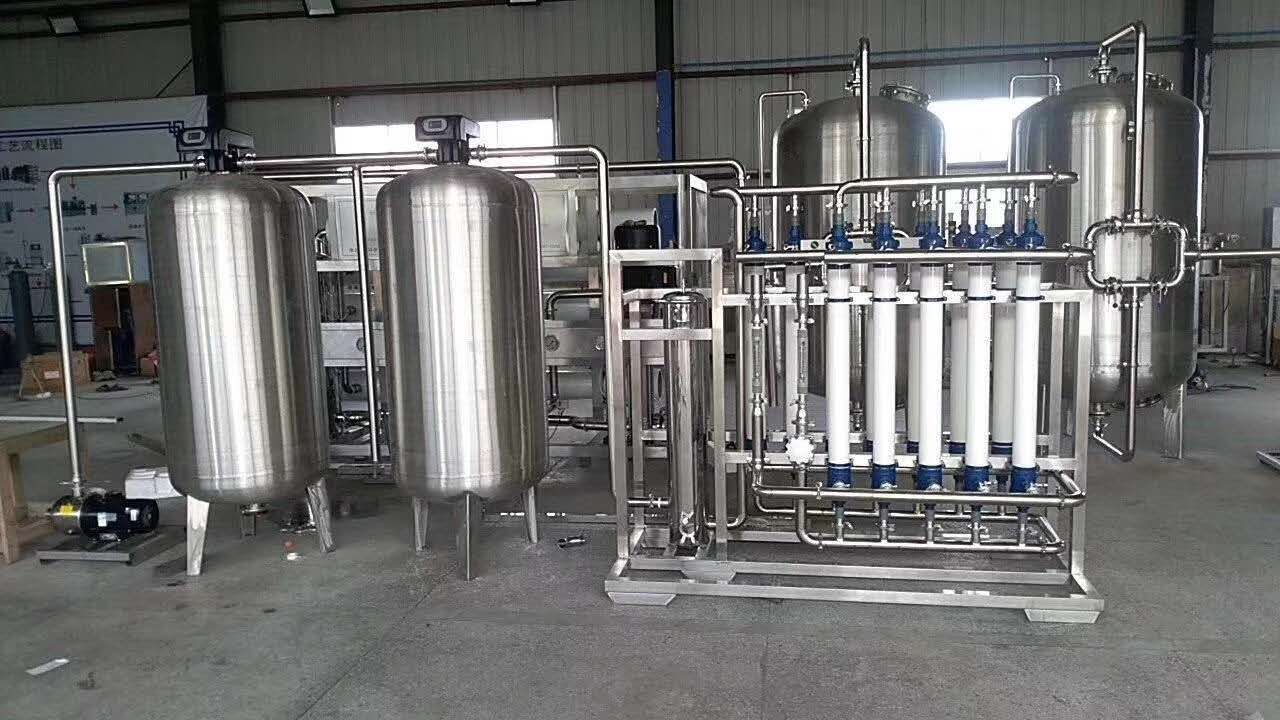
2. Pretreatment Stage: Preparing the Water for RO
Raw water – whether from a well, municipal supply, or surface source – contains suspended solids, organic matter, chlorine, hardness, and sometimes iron or manganese. These must be removed before water reaches the RO membranes, otherwise the membranes will foul quickly and require frequent cleaning or replacement.
Typical pretreatment train:
- Multi-media filtration: Removes larger suspended particles, reduces turbidity, and protects downstream units. This is the first physical barrier.
- Activated carbon filtration: Adsorbs chlorine, organic compounds, and improves taste/odor. Chlorine will damage polyamide RO membranes, so carbon filtration is essential for municipal water.
- Water softening (ion exchange)
- : Replaces calcium and magnesium ions with sodium, preventing scale formation on RO membranes. For high-hardness water, a softener is strongly recommended.
- Cartridge / precision filtration: A 5-micron or 1-micron filter as final protection before the high-pressure pump. This catches any particles that escaped upstream.
Boundary condition: If the raw water has high turbidity or organic load, additional measures like coagulation, flocculation, or ultrafiltration (UF) may be needed. The pretreatment design must be site-specific.
3. Reverse Osmosis (RO) – The Core Purification Technology
RO is the heart of a purified water system. It uses a semi-permeable membrane to reject dissolved solids, bacteria, pyrogens, and most organic molecules. Water is forced through the membrane under pressure; the purified stream (permeate) is collected, while the concentrated stream (concentrate) is discharged or recycled.
Two configurations are common:
- Single-stage RO: Suitable when feed water TDS (total dissolved solids) is relatively low and product water specification is not extremely strict. Typical rejection rate is 95–98%.
- Two-stage RO (double-pass): The permeate from the first RO passes through a second RO unit, achieving overall rejection above 99% and producing water with very low conductivity. This is standard for packaged purified water production lines, as seen in Chuxin Mingwei’s fully automatic bottled purified water filling line, which uses dual-stage RO combined with ozone and UV sterilization.
Key parameters to monitor: Feed water pressure, permeate flow, differential pressure across membranes, and conductivity. RO membranes are sensitive to temperature, pH, and fouling; regular cleaning and replacement based on operating data – not fixed calendar intervals – ensures consistent performance.
4. Disinfection: Ozone, UV, and Combined Approaches
After RO, the water is essentially “pure” but still vulnerable to microbial contamination in storage and distribution. Disinfection provides a safety barrier.
- Ozone: Ozone is a powerful oxidant that kills bacteria and viruses. It is injected into the water via an ozone generator and mixing device. Ozone leaves a residual that continues to protect the water in the storage tank and during filling. However, it needs to be controlled: too little is ineffective, too much can create disinfection byproducts and affect taste. Ozone off-gas must be properly destroyed.
- Ultraviolet (UV): UV light at 254 nm damages microbial DNA, providing physical disinfection without chemicals. UV effectiveness depends on water clarity, flow rate, lamp age, and quartz sleeve cleanliness. UV does not leave a residual, so it is often used in combination with ozone for a dual-barrier approach.
Selection boundary: For products with a short shelf life and no requirement for residual disinfectant, UV alone may be sufficient. For bottled water that may be stored for weeks, ozone is the industry standard. Chuxin Mingwei’s purified water line equips both ozone and UV as standard, providing flexibility.
5. Finished Water Storage and Circulation
After disinfection, the water enters a storage tank – typically a sterile or aseptic tank – and is kept in a closed circulation loop. The loop maintains constant pressure to the filling machine and prevents stagnation. The tank must be sealed, vented with a hydrophobic filter, and periodically cleaned (CIP system). Inline monitoring instruments (conductivity, flow, pressure, temperature) provide real-time data for quality control.
6. Container Cleaning: A Critical but Often Overlooked Step
Container hygiene is a major source of contamination. The cleaning method depends on the container type:
- New bottles (PET, glass): Usually require only a rinse with treated water or air blow. Some lines use a bottle rinser before filling.
- Reusable barrels (e.g., 18.9L polycarbonate): The cleaning process is far more complex. As described in typical barrel filling line designs, the sequence includes: empty barrel inspection, cap removal, external brushing, internal brushing, multi-station wash with detergents and disinfectants, final rinse with finished water, then filling. The number of wash stations, type of disinfectant, and automation level are selected based on barrel condition and production volume.
Boundary condition: For reusable barrels, the key is not just “filling water” – it is the combination of sorting, brushing, multi-stage cleaning, disinfection, final rinse, cap hygiene, and environmental control in the filling room. Skipping or under-specifying any step can lead to quality failure.
7. Filling, Capping, and Packaging
The filling machine must deliver the correct volume (typically ±2 mL accuracy for 18.9L bottles) and maintain a sterile environment. Integrated machines (wash-fill-cap) reduce intermediate exposure and are common in bottle water lines. After capping, inspection stations check fill level, cap presence, and label placement. Then packaging (sleeve, shrink wrap, case packer, palletizer) completes the line.
8. How to Use This Knowledge for Equipment Selection
When discussing a project with a supplier, ask these questions based on the working principle:
- What is the raw water source? Provide a full water analysis report. The supplier will design pretreatment accordingly.
- What is the target water quality standard? National bottled water standard, pharmaceutical grade, or a specific customer specification?
- What is the daily production capacity? This determines the size of RO, storage tank, and filling machine.
- What container type? New bottles or reusable barrels? For barrels, discuss the barrel cleaning process in detail.
- What is the factory layout? Space for pretreatment, RO, storage, filling, cleanroom, and packaging all affect the design.
- What is the budget for maintenance? Higher automation reduces labor but increases reliance on spare parts and technical support.
Chuxin Mingwei customizes each system from the source water evaluation to the final packaging line, ensuring that the equipment matches your actual operating conditions – not a generic template. This approach prioritizes long-term stability and maintainability over lowest upfront cost.
Conclusion
The working principle of purified water equipment is a multi-stage process where each stage has a specific function and a set of boundary conditions. Understanding these stages helps you ask the right questions, compare supplier proposals objectively, and avoid costly mismatches. Whether you need a small bottled water line or a high-capacity barrel filling system, the correct technical foundation is the same: design based on real water quality, real capacity, and real site constraints.
If you are planning a new project or upgrading an existing line, our team can provide a technical evaluation and a tailored proposal. Contact us to discuss your project scope.