
Spring Water Filling Line Working Principle: NF+UF Process Logic, Bottle Handling, and Mineral Retention Explained
Who Needs a Spring Water Filling Line?
A spring water filling line is engineered for producers who bottle natural spring water or mineral water and must preserve the water’s characteristic mineral profile while meeting food safety standards. Unlike purified water lines that rely on reverse osmosis to strip nearly all dissolved solids, a spring water bottling machine treats the water more gently—removing turbidity, microorganisms, and potential contaminants without eliminating the minerals that define the product’s taste and label claims.
This article is written for plant managers, engineering teams, and procurement leads who are evaluating equipment for a new spring water brand or upgrading an existing facility. The focus is on the working principle of Chuxin Mingwei’s bottled spring water filling production line, which combines dual-membrane NF+UF treatment with integrated bottle handling and intelligent control.
Before Adoption: Understanding the Spring Water Treatment Philosophy
Spring water is not simply “untreated water.” Its composition varies with geology, season, and extraction depth. The first step in designing a filling line is a comprehensive source water assessment. Based on that report, engineers select a treatment chain that achieves two contradictory goals: removing harmful substances and microorganisms while retaining beneficial minerals such as calcium, magnesium, and bicarbonate.
This is where the working principle of a spring water bottling machine differs fundamentally from that of a purified water line. Purified water equipment typically uses two-stage RO, which removes over 95% of dissolved solids. Spring water, however, calls for a process that preserves the water’s natural characteristics. In practice, this means replacing or supplementing RO with nanofiltration (NF) and ultrafiltration (UF).
NF membranes have a slightly larger pore size than RO membranes, allowing monovalent ions to pass while rejecting many divalent ions, organic compounds, and pathogens. UF membranes provide an additional physical barrier against bacteria, viruses, and fine particulates without adding chemicals. When combined, NF and UF achieve a balance of purification efficiency and mineral retention. This dual-membrane logic is the core of Chuxin Mingwei’s spring water treatment approach.
During Adoption: The Core Working Principle and Process Logic
1. Source Water Receiving and Pre-Treatment
Raw spring water is first directed into a storage tank and then pumped through a pre-treatment train. Depending on the source water quality, this may include multi-media filtration to remove larger suspended solids, activated carbon to reduce color, odor, and organic matter, and precision filtration to protect downstream membranes. Pre-treatment stabilizes the incoming water quality and extends the service life of the NF and UF membranes.
2. NF+UF Dual-Membrane Purification
After pre-treatment, the water enters the heart of the system: the NF and UF membrane units. Nanofiltration removes a controlled fraction of dissolved salts, heavy metals, and micro-organic pollutants while allowing desirable minerals to pass through. Ultrafiltration then acts as a final physical barrier, removing bacteria, viruses, and sub-micron particles. This step does not rely on chemical disinfection to achieve its microbial reduction; instead, it provides a measurable, physical removal mechanism.
Chuxin Mingwei’s spring water line is designed so that the NF and UF stages can be configured according to the specific mineral targets and microbiological risk profile of the source water. The system is not a one-size-fits-all package—it is built around the water report, not the other way around.
3. Safe Disinfection and Product Water Storage
After UF, the water typically undergoes a gentle disinfection step, often with ultraviolet (UV) radiation at 254 nm, and may be further supported by ozone dosing for residual protection in the bottling process. The treated water is then transferred to a sterile product water tank, where it is kept in a controlled, continuously circulating loop to prevent stagnation and microbial regrowth. The storage and delivery system includes online monitoring of conductivity, flow, and pressure, ensuring that the water quality remains stable before it reaches the filling machine.
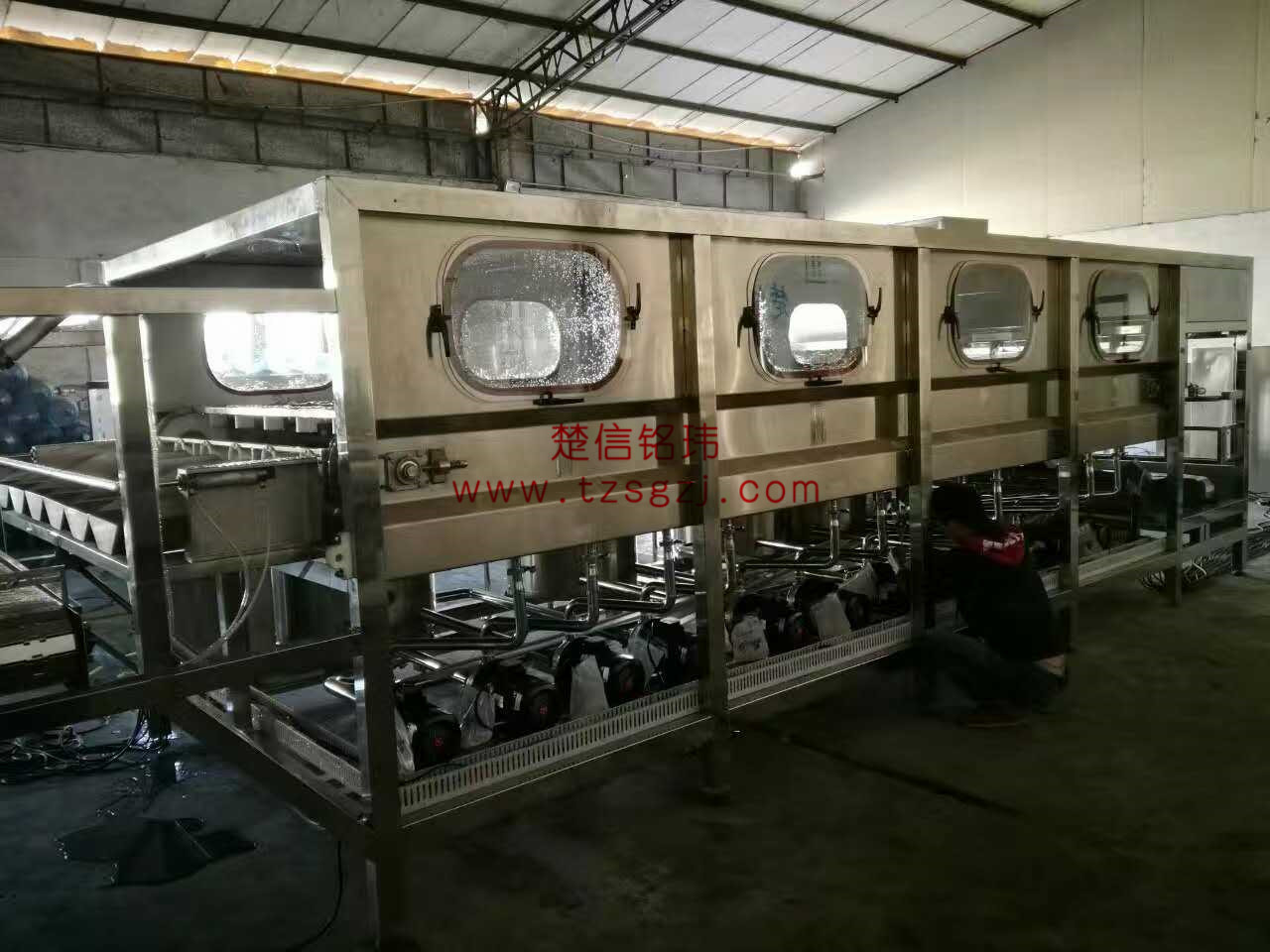
4. Integrated Bottle Washing, Filling, and Capping
Empty bottles are fed into a three-in-one monoblock unit that combines washing, filling, and capping in a single, enclosed machine. This design minimizes bottle exposure to ambient air and reduces the risk of secondary contamination.
- Bottle Washing:*
- New or rinsed bottles are inverted and sprayed with treated water (and sometimes sanitizing solution) to remove any dust or debris.
- Filling:*
- The cleaned bottles are then filled with product water using a volumetric or gravity-based filling system, depending on the configuration. For 18.9 L, 11.3 L, and 5 L bottles, the system achieves a filling accuracy of ≤ ±2 mL, helping to maintain consistent net content.
- Capping:*
- Immediately after filling, caps are fed from a cap sorter and applied. The capping pass rate is ≥99.6%, a critical parameter for preventing leakers and ensuring tamper evidence.
This integrated workflow is controlled by a PLC-based system that synchronizes the speed of the bottle conveyor, filler, and capper. Operators can adjust parameters through an HMI touchscreen, and the system supports recipe management for different bottle sizes.
5. Post-Filling Inspection and Packaging
After capping, bottles pass through a light inspection station where operators or automated sensors check for visible defects, incorrect fill levels, or missing caps. The line can then include labeling, shrink sleeving, date coding, and secondary packaging such as shrink-wrapping or cartoning. The specific configuration depends on the customer’s product format and market requirements.
After Adoption: Application Boundaries and Operational Considerations
A spring water filling line is not a universal solution. Its performance and output depend on several boundary conditions:
- Source Water Stability:*
- If the source water composition changes dramatically with seasons, the pre-treatment and membrane configuration may need to be adjusted. The line is designed for a defined water quality range; significant deviations require re-validation.
- Mineral Claims:*
- The NF+UF process helps retain minerals, but it does not add minerals. If the raw water is naturally low in certain minerals, the bottled product will reflect that. The equipment cannot enhance mineral content beyond what the source provides.
- Capacity Limits:*
- The rated output of Chuxin Mingwei’s spring water filling line ranges from 200 to 1,800 bottles per hour (based on 18.9 L bottles). Actual throughput depends on bottle size, filling volume, and the efficiency of upstream and downstream equipment. A line that is designed for 18.9 L bottles will not run at the same speed with 5 L bottles without adjustments.
- Cleaning and Maintenance:*
- The NF and UF membranes require regular cleaning-in-place (CIP) based on differential pressure and normalized flow trends, not a fixed calendar schedule. Operators must maintain detailed logs of membrane performance, UV intensity, and ozone residuals to ensure consistent product safety.
- Cleanroom Integration:*
- The filling machine must operate in a controlled environment. Chuxin Mingwei can integrate the line with a clean air purification system that meets ISO Class 8 (100,000) or higher standards, providing positive pressure and HEPA-filtered air to the filling zone. This is not an optional accessory; it is a necessary part of the microbial control strategy.
Conclusion: Matching the Machine to the Water
The working principle of a mineral water bottling machine is not just about mechanical movement—it is about the logic of selective treatment, hygienic design, and parameter-driven control. A well-engineered spring water filling line, such as Chuxin Mingwei’s NF+UF-based system, acknowledges that every spring water source is different and that the equipment must be configured accordingly. By understanding the process logic from raw water assessment to finished bottle inspection, buyers can make informed decisions and avoid the mistake of applying a purified water mindset to a mineral water project.
For a line that is tailored to your specific source water report and production goals, contact our engineering team to discuss your project requirements.