
Two-Stage Reverse Osmosis System Components List: Core Equipment & Function Overview
Two-Stage Reverse Osmosis System Components List: Core Equipment & Function Overview
For procurement managers and operations leads in the beverage, food, and pharmaceutical sectors, selecting a water treatment system is not just about buying a machine; it is about engineering a process that guarantees stable water quality over years of operation. A two-stage reverse osmosis (RO) system is the industry standard for producing high-purity water, particularly when source water has high total dissolved solids (TDS) or when strict conductivity limits are required for bottled purified water production.
Unlike single-stage systems, a two-stage configuration passes the permeate (product water) from the first stage through a second set of membranes. This significantly improves salt rejection and stabilizes output quality against fluctuations in raw water conditions. However, the efficiency of the RO membranes relies entirely on the supporting components upstream and downstream.
This guide details the specific components included in a professional two-stage RO system, their functions, and the critical selection criteria based on real-world engineering practices.
1. Raw Water Intake and Pre-Treatment Unit
The most common cause of RO membrane failure is not the membrane itself, but inadequate pre-treatment. The pre-treatment section prepares the raw water to meet the strict inlet requirements of the RO membranes, specifically controlling turbidity, residual chlorine, and hardness.
Raw Water Tank and Boost Pump
The system begins with a raw water tank to buffer supply fluctuations, followed by a boost pump. This pump provides the initial pressure required to push water through the pre-treatment filters. Without stable inlet pressure, the entire system's flow rate becomes erratic.
Multi-Media and Activated Carbon Filters
- Multi-Media Filter:*
- Typically filled with quartz sand and anthracite, this unit removes suspended solids, silt, and larger particulates. Its primary role is to reduce turbidity and protect downstream equipment from physical clogging.
- Activated Carbon Filter:*
- This is critical for protecting RO membranes. As noted in industry best practices, activated carbon adsorbs residual chlorine, odors, and organic compounds. Since standard polyamide RO membranes are highly sensitive to oxidative damage from chlorine, this step is non-negotiable for municipal water sources.
Water Softener (Optional but Recommended)
For source water with high hardness (calcium and magnesium), a softener using ion exchange resin is essential. It prevents scale formation on the membrane surface, which can drastically reduce flux and increase operating pressure. The decision to include a softener depends on a detailed analysis of the raw water report.
Precision Security Filter
Before entering the high-pressure pump, water passes through a security filter (typically 5-micron cartridge filters). This acts as the final safeguard, trapping any fine particles that may have bypassed previous stages, ensuring no physical damage occurs to the high-pressure pump or membrane elements.
2. The Core: Two-Stage Reverse Osmosis Assembly
The heart of the system consists of two distinct stages of membrane separation, connected in series.
First-Stage RO Unit
- High-Pressure Pump:*
- Delivers water at the specific pressure required to overcome osmotic pressure and force water through the membrane. The pump's material (often stainless steel 304 or 316) and motor efficiency are vital for long-term reliability.
- RO Membrane Housing and Elements:*
- The first stage typically uses low-pressure composite membranes. It removes approximately 96-98% of dissolved salts, organics, and microbes. The concentrate (reject water) from this stage is either discharged or partially recycled, depending on the recovery rate design.
Intermediate Water Tank (Optional)
In some configurations, an intermediate tank is placed between the two stages to stabilize flow and allow for pH adjustment if necessary, though direct coupling is common in compact lines.
Second-Stage RO Unit
- Second High-Pressure Pump:*
- Takes the permeate from the first stage and boosts it for the second pass. Since the inlet water is already partially purified, this pump often operates at different pressure parameters than the first.
- Second-Stage Membranes:*
- These membranes polish the water further, achieving final conductivity levels often required for purified drinking water standards (e.g., <10 µS/cm). The concentrate from the second stage is usually recycled back to the raw water tank or the inlet of the first stage to maximize water utilization.
Control and Monitoring Instrumentation
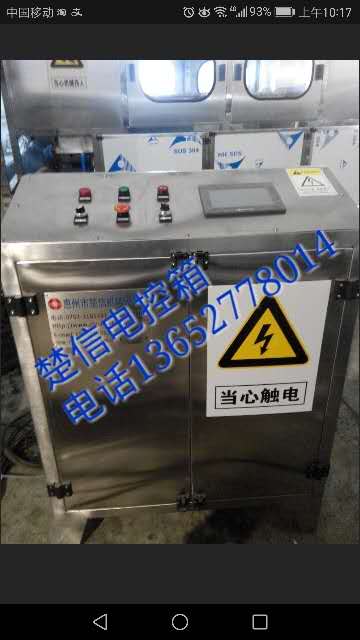
A robust PLC-based control system monitors inlet pressure, inter-stage pressure, outlet pressure, flow rates, and conductivity at multiple points. Automated valves manage flushing, production, and cleaning cycles. Real-time diagnostics allow operators to detect membrane fouling or pump issues before they cause downtime.
3. Post-Treatment, Disinfection, and Storage
Producing pure water is only half the battle; maintaining its quality until the point of filling is equally critical.
UV Sterilizer and Ozone Generator
- UV Sterilizer:*
- Typically using 254 nm lamps, this unit provides immediate physical disinfection of the product water, breaking down microbial DNA without adding chemicals.
- Ozone Generator:*
- For bottled water applications, ozone is often injected into the water and the empty containers. It provides a residual disinfectant effect that UV cannot offer. However, dosage must be carefully controlled to avoid taste issues or material degradation.
Pure Water Storage Tank
A stainless steel sterile tank (often 304 or 316L grade) stores the finished product. These tanks are equipped with breathing filters (hydrophobic vents) to prevent airborne contamination during level changes. Level sensors automate the start/stop of the RO system to prevent dry running or overflow.
Distribution Loop and CIP System
To prevent stagnation and bacterial regrowth, a circulation loop with a variable frequency drive (VFD) pump keeps water moving. Periodically, the system requires Clean-In-Place (CIP) capabilities. A dedicated CIP skid allows for chemical cleaning of membranes and pipelines without disassembly, restoring flux and extending membrane life.
Implementation Prerequisites and Selection Criteria
Deploying a two-stage RO system requires more than just floor space. Successful implementation depends on several site-specific factors:
- Raw Water Analysis: A comprehensive water quality report is the foundation of design. Parameters like TDS, hardness, silica, iron, and chlorine levels dictate the pre-treatment configuration. Without this data, component selection is merely guessing.
- Capacity and Recovery Rate: Determine the required hourly output (e.g., 1,000 L/h to 50,000 L/h). The system's recovery rate (the ratio of product water to raw water) must be balanced against source water quality to minimize waste while preventing scaling.
- Utility Conditions: Verify available power (voltage, phase), drainage capacity for concentrate discharge, and ambient temperature ranges, as water viscosity and membrane performance vary with temperature.
- Regulatory Compliance: For food and beverage applications, all wetted parts must comply with relevant food safety standards (e.g., GB4806 in China or FDA/NSF internationally).
Common Risks and Boundaries
- Membrane Fouling:*
- Even with pre-treatment, membranes will eventually foul. A well-designed system includes easy access for cleaning and clear indicators (pressure differential) to signal when maintenance is needed.
- Chemical Compatibility:*
- Ensure all seals, gaskets, and piping materials are compatible with the specific cleaning agents and disinfectants (like ozone) used in your facility.
- Not a Magic Bullet:*
- A two-stage RO system removes dissolved ions effectively but is not designed to remove specific volatile organic compounds (VOCs) or gases without additional specialized media (like degasifiers or specific carbon blends).
Next Steps for Your Project
Selecting the right components for a two-stage RO system is a balance of engineering precision and operational practicality. At Chuxin Mingwei, we do not offer off-the-shelf boxes; we engineer solutions based on your specific water source, target capacity, and facility constraints.
Since 2008, we have delivered customized water treatment and filling lines for clients across the beverage and industrial sectors. Our process begins with a detailed requirement confirmation, including water testing and site surveys, followed by a tailored design that integrates seamlessly with your existing or planned production line.
Ready to define your water treatment solution?
Share your raw water report and production targets with our engineering team. We will provide a preliminary component list, process flow diagram, and budget estimation tailored to your project needs.
Request a Solution Consultation