
Integrating a Barrel-Wrap Packaging Machine in 18.9L Spring Water Filling: Preserving Minerals and Ensuring Sterilizatio
Integrating a Barrel-Wrap Packaging Machine in 18.9L Spring Water Filling: Preserving Minerals and Ensuring Sterilization
For technical evaluators, operations leads, and procurement managers navigating the first-time adoption of 18.9L bottled water equipment, the engineering challenge extends beyond water treatment. A successful bottled spring water production line must preserve the natural mineral profile of the source water, ensure strict sterilization compliance, and seamlessly integrate downstream automation like a barrel-wrap packaging machine.
Unlike purified water, spring water cannot be subjected to aggressive filtration without losing its core market value. Furthermore, the final packaging stage for 3-gallon and 5-gallon barrels is critical for maintaining hygiene and structural integrity during transport. Based on real-world deployment scenarios, this guide outlines factual selection criteria and condition-based boundaries for integrating filling and packaging systems.
1. Balancing Mineral Retention and Sterilization in 18.9L Barrels
The Engineering Reality: Reverse Osmosis (RO) is highly effective for purified water but strips beneficial minerals. For natural spring water, a dual-membrane NF (Nanofiltration) + UF (Ultrafiltration) process is the standard requirement.
Conditions & Boundaries:
When configuring NF spring water equipment, the exact mineral composition of the source water dictates the membrane pore size and operating pressure. To ensure microbiological safety without altering the taste profile or creating chemical byproducts, modern spring water filling equipment relies on integrated ozone and UV (254 nm) dual sterilization.
Crucial Boundary: Regulatory frameworks for packaged drinking water vary significantly by region. Project teams must verify the current official food safety standards in their target market before finalizing sterilization protocols, rather than relying on outdated industry references.
2. The Critical Role of the Barrel-Wrap Packaging Machine
The Engineering Reality: Filling 18.9L (5-gallon) barrels is only half the process. Whether using new or recycled barrels, the final product requires secure sealing and exterior protection. A barrel-wrap packaging machine (often utilizing heat-shrink film) is essential for sealing the cap to prevent tampering and protecting the barrel exterior during logistics.
Conditions & Boundaries:
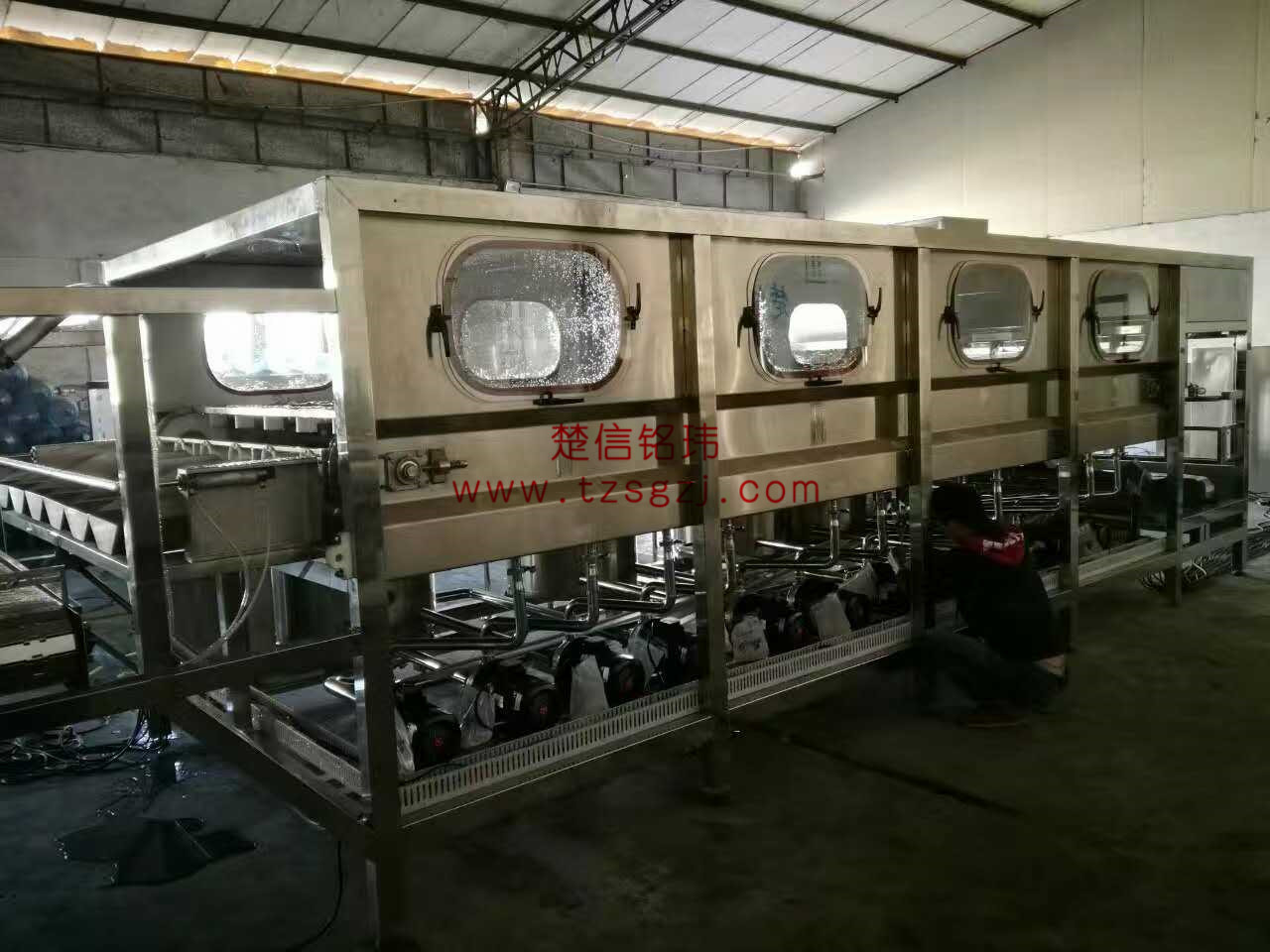
- Recycled vs. New Barrels:*
- If the line processes recycled barrels, the workflow must include inspection, de-capping, exterior brushing, multi-stage internal washing, and disinfection before filling. The barrel-wrap packaging machine serves as the final hygienic seal after capping.
- Speed Synchronization:*
- A typical 18.9L bottled water equipment line operates at 200–1,800 bottles/hour. The barrel-wrap packaging machine must be precisely synchronized with the filling and capping monoblock. If the transition conveyors are mismatched, micro-stoppages will degrade the line's overall efficiency and potentially damage the barrels.
3. Defining True Capacity: OEE Over Peak Speed
The Engineering Reality: A production line rated for a specific output is only as capable as its slowest or most unstable component—often the transition between the filler and the barrel-wrap packaging machine.
Conditions & Boundaries:
Peak speed metrics are misleading. Acceptance testing for the entire spring water filling equipment setup must be based on continuous run time, overall pass rate, specific barrel formats, and allowed downtime. True Overall Equipment Effectiveness (OEE) is validated under stable operating conditions, ensuring the packaging machine maintains consistent film tension and sealing temperature without jamming.
4. Facility Integration and Cleanroom Requirements
The Engineering Reality: A commercial 18.9L bottling facility is a closed-loop ecosystem. The washing, filling, and capping zones must be isolated to prevent secondary contamination.
Conditions & Boundaries:
Integrating ISO Class 8 (100,000) clean air purification systems with H13 HEPA filtration is often mandatory for the filling zone. Equipment layout must adapt to facility constraints, including drainage, airflow, and operator access. As a Huizhou water treatment manufacturer, Chuxin Mingwei emphasizes that equipment capabilities must map directly to real-world operational contexts. Standardized machines rarely fit the unique footprint and water chemistry of a new spring water project.
Execution Advice for Technical Evaluators
- Conduct Source Water Analysis: Obtain a comprehensive water quality report to determine if NF+UF is sufficient or if specific pre-treatment is required.
- Define the Packaging Matrix: Confirm the exact barrel sizes (e.g., 3-gallon, 5-gallon/18.9L), cap types, and whether recycled barrels will be used. This ensures the washing-filling-capping monoblock and the barrel-wrap packaging machine are tooled correctly.
- Verify Local Compliance: Consult with local regulatory bodies to confirm the exact sterilization, packaging, and labeling requirements for your target market.
Conclusion
Selecting a comprehensive 18.9L bottled spring water production line is an exercise in balancing competing variables: mineral retention versus sterilization, and filling speed versus packaging synchronization. By focusing on site-specific engineering, dual-membrane filtration, and the seamless integration of a barrel-wrap packaging machine, technical teams can build a foundation for long-term maintainability and compliance.