
Can Cola, Soda, and Sparkling Water Share One Production Line? Process Compatibility & Validation Guide
Can Cola, Soda, and Sparkling Water Share One Production Line?
For beverage manufacturers planning facility expansion or new product launches, a common strategic question arises: Can a single production line efficiently handle cola, soda, and sparkling water?
The short answer is yes, technically, as all three products fall under the category of carbonated beverages requiring isobaric (counter-pressure) filling. However, the practical feasibility depends entirely on specific process constraints, including syrup dosing accuracy, CO2 saturation levels, packaging formats, and the rigor of your changeover cleaning protocols.
At Chuxin Mingwei, we engineer water treatment and filling systems based on actual source water quality, target standards, and facility constraints. When evaluating a shared line for diverse carbonated products, buyers must look beyond the basic "filling machine" specification and assess the entire system's adaptability.
Core Technical Compatibility: The Isobaric Principle
Cola, standard soda, and plain sparkling water all share a fundamental requirement: they must be filled under pressure to retain dissolved CO2 and prevent foaming. This means the core filling unit must be an isobaric filler.
- Shared Capability:*
- A modern rotary isobaric filling machine can physically handle the pressure ranges required for these products (typically 0.2–0.4 MPa depending on temperature and carbonation level).
- The Divergence Point:*
- While the mechanism is the same, the process parameters differ significantly. Cola involves high-viscosity syrup dosing and complex flavor injection; soda may require different acid/sugar ratios; sparkling water requires precise carbonation without any syrup interference.
Critical Selection Criteria for Multi-Product Lines
When procuring equipment intended for mixed production, procurement managers and operations leads should evaluate the following specific capabilities:
1. Syrup Dosing Precision and Flexibility
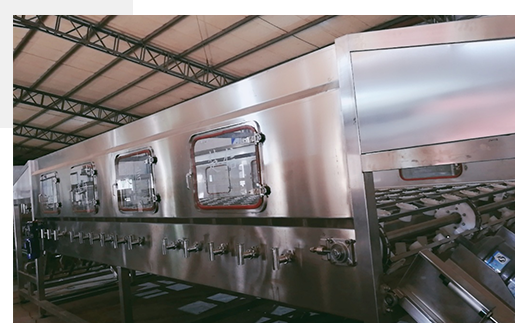
Cola production requires highly accurate syrup-to-water ratios (often via a proportional mixer or in-line blender). If the same line is used for plain sparkling water, the syrup system must be completely isolated or capable of being flushed to zero residual without cross-contamination.
- Risk:*
- Residual syrup in valves or mixing chambers can spoil a batch of plain sparkling water.
- Requirement:*
- Look for filling valves with independent product and syrup channels, or a modular mixing system that allows for rapid switching between "pre-mix" (for soda/cola) and "water-only" modes.
2. CO2 Pressure and Saturation Control
Different products demand different levels of carbonation (volumes of CO2). Sparkling water often requires higher, more stable carbonation than some fruit sodas.
- Constraint:*
- The carbonator and the filler bowl pressure control system must have a wide operating range and fast response times.
- Validation:*
- Ensure the PLC control system can store distinct recipes for each product, automatically adjusting CO2 pressure, filling temperature, and back-pressure settings upon changeover.
3. Packaging Format Compatibility
As noted in industry equipment standards, compatibility often hinges on bottle geometry. Whether you are using PET bottles for soda or glass for premium sparkling water, the line's bottle handling system is critical.
- Neck Handling:*
- Modern lines often use "neck-handling" technology (suspended bottle transport) to accommodate various bottle shapes (round, square, custom) without changing star wheels extensively.
- Capacity Range:*
- Equipment designed for standard drinking water bottles (e.g., 300–1,500 mL) may need specific adjustments for heavier glass bottles used in premium sparkling water segments. Verify the machine's torque settings and conveyor speed limits for your heaviest container.
Implementation Boundaries and Risks
Sharing a line introduces operational complexities that do not exist in single-product facilities.
Changeover Time and Efficiency
Switching from cola to sparkling water is not instantaneous. It requires a full CIP (Clean-in-Place) cycle to remove sugar, colorants, and flavors.
- Reality Check:*
- A rigorous CIP cycle can take 1–2 hours. If your production schedule requires frequent switches (e.g., morning cola, afternoon sparkling water), your effective daily capacity will drop significantly.
- Recommendation:*
- For high-frequency switching, consider dedicated parallel lines or a "campaign production" strategy (running one product for several days before switching).
Utility Coordination
A multi-product line places higher demands on utilities:
- Water Treatment:*
- The base water quality must meet the strictest standard among your products. If your cola recipe masks minor off-tastes but your sparkling water does not, your RO (Reverse Osmosis) and filtration system must be sized for the highest purity requirement.
- Air and Gas:*
- Ensure your compressed air system is oil-free and your CO2 supply can handle peak demand spikes during high-speed filling of highly carbonated products.
Supplier Evaluation Checklist
When discussing this project with equipment manufacturers like Chuxin Mingwei, focus your inquiry on these execution details rather than generic capacity claims:
- Recipe Management: Does the HMI allow one-touch switching of all critical parameters (pressure, temperature, dosing ratio)?
- Valve Design: Are the filling valves designed to minimize dead zones where syrup could stagnate?
- CIP Coverage: Can the supplier demonstrate CIP flow rates and coverage for the specific valve types used in your mixed line?
- Material Certification: Ensure all contact parts are 304 or 316 stainless steel, compliant with food safety standards for both acidic sodas and neutral sparkling water.
Conclusion and Next Steps
Yes, cola, soda, and sparkling water can share a production line, but only if the system is engineered with flexible dosing, robust pressure control, and efficient cleaning protocols from the start. The risk lies not in the hardware's inability to fill, but in the operational inefficiency and quality risks caused by poor changeover design.
If you are planning a facility that targets multiple carbonated categories, do not rely on standard "off-the-shelf" configurations. Your solution requires a custom assessment of your specific product recipes, bottle types, and shift patterns.
Get Started With Your Project
Share your target product list (cola, soda, sparkling water), desired capacity, and packaging formats. Our engineering team will analyze your process compatibility and propose a tailored solution that balances flexibility with operational stability.
Request a Solution Consultation