
Integrated vs. Standalone Units: A Technical Checklist for First-Time 10L–18.9L Barrel Filling Line Buyers
Integrated vs. Standalone Units: A Technical Checklist for First-Time 10L–18.9L Barrel Filling Line Buyers
If you’re evaluating your first barrelled water filling line for 10L to 18.9L containers—whether for spring water, purified water, or other potable products—you’ll quickly encounter a fundamental architecture choice: an integrated wash-fill-seal (WFS) system versus separate washing, filling, and capping units. While both can meet output targets, the right choice hinges less on speed and more on your site’s physical constraints, hygiene requirements, and long-term operational model.
Chuxin Mingwei’s engineering approach prioritizes product-scenario matching—meaning the system is designed around your actual source water, target standards, packaging format, and facility layout. For barrel production in the 10L–18.9L range, this often leads to recommending an integrated WFS unit, but not universally. Below is a practical checklist for technical evaluators forming a shortlist.
When an Integrated Wash-Fill-Seal System Is Preferable
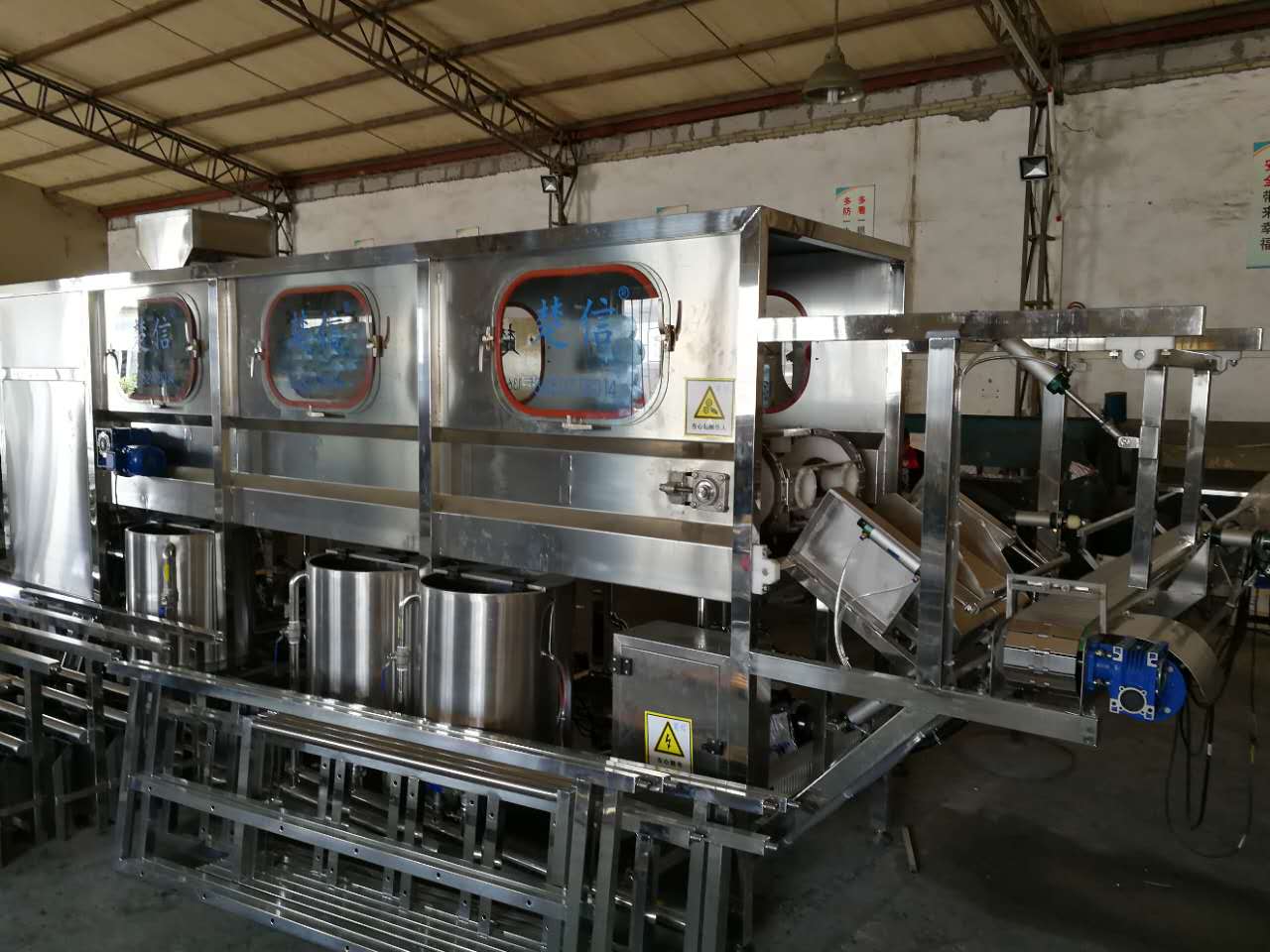
An integrated WFS system combines bottle (or barrel) rinsing, filling, and capping into a single synchronized machine with a continuous transport path. This design minimizes open-air exposure between steps—a critical factor for maintaining microbiological integrity, especially in non-sterile environments.
Key conditions favoring integration:
- Limited cleanroom footprint: If your facility has constrained space for zoning (e.g., no dedicated pre-wash, fill, and post-cap areas), an integrated unit reduces the required ISO Class 8 cleanroom volume.
- High sanitation priority: For spring water or products requiring mineral retention (where post-filtration disinfection is limited), minimizing airborne recontamination during transfer is essential.
- First-time deployment: New operators benefit from simplified process control—PLC-based systems synchronize all three functions, reducing manual intervention and training complexity.
- Consistent barrel type: If you’re using standard 18.9L (5-gallon) or 11.3L barrels with fixed neck dimensions, integration ensures precise alignment across stations.
Chuxin Mingwei’s bottled spring water lines use an integrated washing-filling-capping unit that achieves tight mechanical synchronization, supporting consistent filling accuracy and reliable capping performance under defined operating conditions.
When Separate Units May Be Justified
Standalone units offer modularity but introduce interfaces where contamination or misalignment can occur. They may be considered only if:
- You already own functional washing or capping equipment and seek partial upgrades.
- Your operation handles multiple barrel types (e.g., 10L square + 18.9L round) requiring frequent changeovers better managed with dedicated modules.
- Utility infrastructure (water, air, power) is distributed in a way that makes centralizing equipment impractical.
However, note that separate units typically require additional conveyors, interlocks, and buffer zones—increasing both footprint and validation effort during commissioning.
Critical Pre-Installation Conditions to Verify
Regardless of architecture, Chuxin Mingwei’s delivery workflow requires confirmation of several site-specific factors before final design:
- Barrel specifications: Diameter, height, neck finish, material (PC vs. PET), and whether barrels are new or returnable.
- Utility readiness: Clean-in-place (CIP) water quality, compressed air dew point, electrical phase/voltage, and drainage capacity.
- Integration with air handling: If your filling zone must meet ISO Class 8 (100,000) standards—as is common for beverage and pharma applications—the WFS unit must be coordinated with HEPA-filtered airflow patterns and pressure cascades.
Our industrial clean air solutions are engineered with site-specific duct routing and pressure zoning, ensuring the filling environment remains compliant without overdesigning airflow.
Long-Term Support & Maintainability Considerations
Integrated systems simplify maintenance access when designed with serviceability in mind. Chuxin Mingwei includes operator training and after-sales support as part of end-to-end delivery—not as optional add-ons. This is especially valuable for first-time adopters who lack in-house expertise in membrane filtration, ozone dosing, or PLC diagnostics.
Avoid vendors who quote high-speed output (e.g., “2,500 barrels/hour”) without specifying test conditions. Real-world capacity depends on barrel size, rinse cycle duration, and filling viscosity. As noted in industry practice, output must be tied to a defined bottle/barrel type and operating protocol—not a theoretical maximum.
Next Steps for Technical Evaluators
If your project involves custom water treatment paired with barrel filling, begin by sharing:
- Your target water standard (e.g., GB 19298 for packaged drinking water)
- Source water report (TDS, hardness, microbial load)
- Facility layout with utility points marked
- Expected daily output in finished barrels (not just “bottles/hour”)
With these inputs, Chuxin Mingwei can map equipment capabilities to your operational context—clarifying whether an integrated WFS system delivers stability, applicability, and long-term maintainability for your specific case.